Tag: Bamboo

  • Running Bamboo: What It Is and How to Contain It (Root Barrier Guide)

    Running Bamboo: What It Is and How to Contain It (Root Barrier Guide)

    Running bamboo has a reputation, and honestly, it earned it.

    It’s gorgeous. It’s fast. And left alone, it will happily come up in the next bed over, under the fence, and in the middle of somebody else’s lawn.

    The good news: it’s very containable if you plan for it before you plant, not after.

    Quick answer: Running bamboo spreads by long underground rhizomes. Contain it with a continuous root barrier sunk about 2 to 2½ feet deep with a couple of inches left above ground, or by cutting around the planting every year to sever new rhizomes. Check the barrier’s top edge every year, because rhizomes will try to go over it.

    Disclosure: As an Amazon Associate, I may earn from qualifying purchases. Some links are affiliate links and don’t cost you anything extra. Product photos and scene images are for display and inspiration only and may not show the exact item linked.

    What is running bamboo?

    All bamboo spreads by rhizomes, the underground stems that send up new canes. The difference is the shape.

    • Clumpers have short, curved rhizomes that turn up close to the parent. The clump widens slowly. (Here’s how to plant and care for clumping bamboo.)
    • Runners have long, thin rhizomes that travel horizontally and send up canes along the way, sometimes many feet from where you planted.

    Most running bamboo in gardens is Phyllostachys (golden bamboo, black bamboo, yellow groove, Moso), plus smaller runners like Pleioblastus and Sasa.

    The rhizomes mostly stay fairly shallow, usually in the top foot or so of soil. That’s exactly why a barrier works.

    Why containment matters

    • It can push into lawns, beds and neighboring yards.
    • It’s hard to dig out once it’s established.
    • Some states and towns regulate running bamboo, or make the owner responsible if it spreads onto a neighbor’s property.

    Check your local rules before you plant. It takes five minutes and can save a fight.
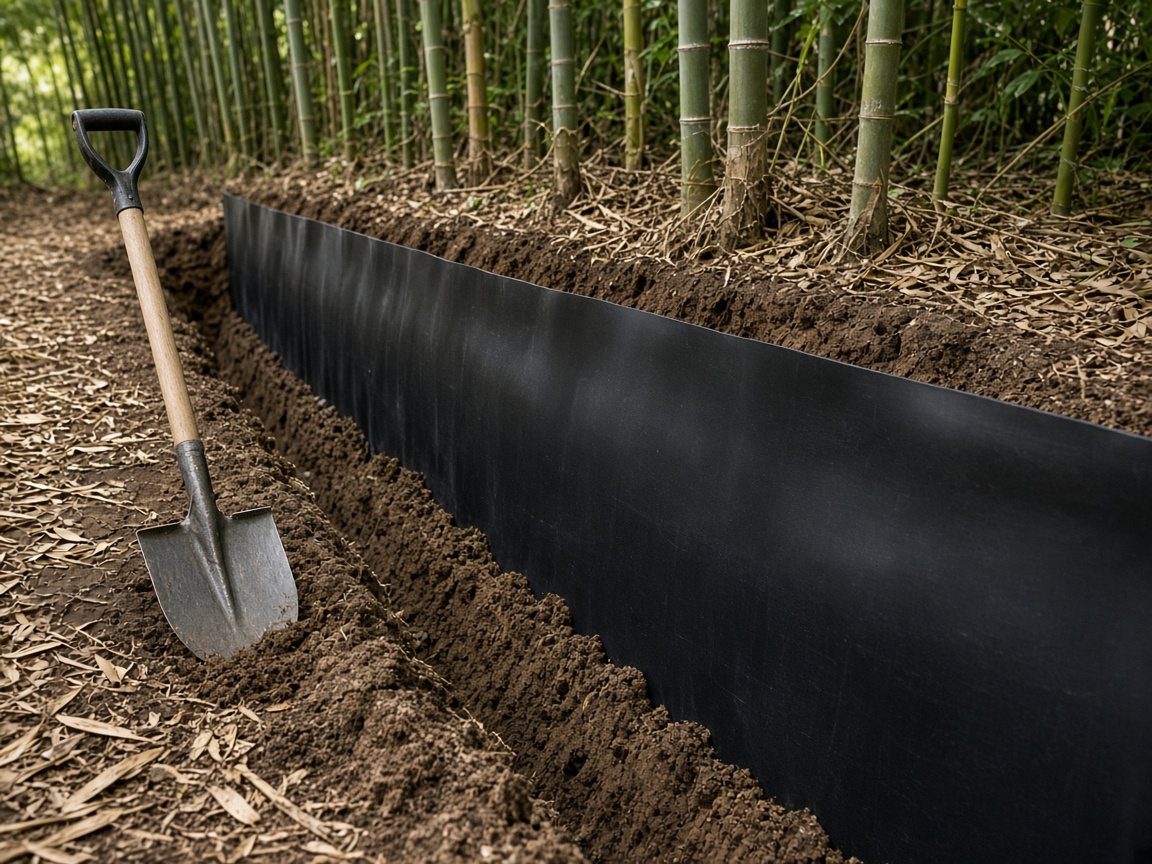
    Trench beside a bamboo grove with a black HDPE root barrier set vertically, top edge above the soil
    Set the barrier vertically in the trench with a couple of inches showing above grade (illustration).

    Option 1: Install a root barrier

    This is the one most people should do.

    Pick the right material

    The standard is a purpose-made bamboo barrier: thick, smooth, high-density polyethylene (HDPE) sold in rolls. Smooth matters. Rhizomes slide along it instead of digging in.

    What doesn’t work well: landscape fabric (they go straight through), thin plastic, and anything with gaps. Concrete and metal can work but are heavy, expensive and hard to seal at every joint. A crack or seam is all a rhizome needs.

    If you are shopping for barrier, look for a smooth HDPE roll deep enough for a 2 to 2½ foot trench with a lip left above the soil.

    As an Amazon Associate, I may earn from qualifying purchases.

    Measure

    Walk the outline of the area you want the bamboo to fill. Measure the perimeter and add extra for the overlap where the ends meet. Bigger is kinder. A cramped circle gets root-bound fast.

    Dig the trench

    Dig a narrow trench around the whole perimeter, about 2 to 2½ feet deep. Many barrier makers sell 24- to 30-inch rolls for exactly this reason.

    Set the barrier

    1. Stand the barrier in the trench with about 2 inches sticking up above the soil. That lip is what stops rhizomes hopping over the top.
    2. Angle the top edge slightly outward, away from the bamboo. Rhizomes that hit it get steered up, not under.
    3. Overlap the ends generously and seal the seam with the joining strip or tape the manufacturer recommends. The seam is the weak spot.
    4. Backfill and firm the soil on both sides, then water it in.

    Check it every year

    Late summer or fall, walk the edge. Any rhizome that’s climbing over the lip, cut it and pull it back inside. That’s ten minutes a year, and it’s the part people skip.
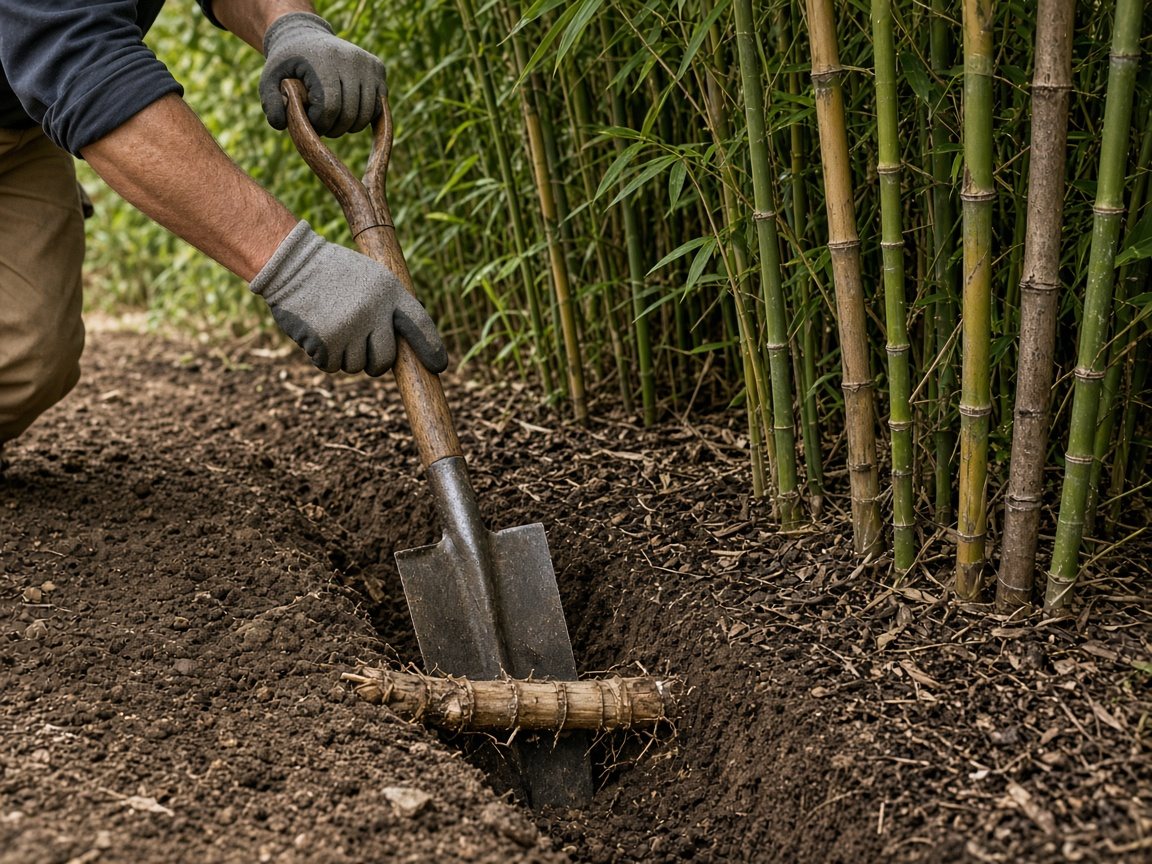
    Spade slicing down along the edge of a bamboo patch, exposing a cut rhizome
    A sharp spade along the edge severs wandering rhizomes before they travel (illustration).

    Option 2: Rhizome pruning (no barrier)

    If you’d rather not bury plastic, you can contain runners by cutting.

    Once a year, usually late summer or fall after the shoots have finished, push a sharp spade straight down all the way around the planting, about a foot deep. Pull out anything you’ve severed on the outside.

    It works. It just has to happen every single year.

    Option 3: Shoots and mowing

    New shoots that come up where you don’t want them can be snapped or mowed off. A shoot that’s cut won’t come back as a cane. It’s a good backup, not a strategy on its own.
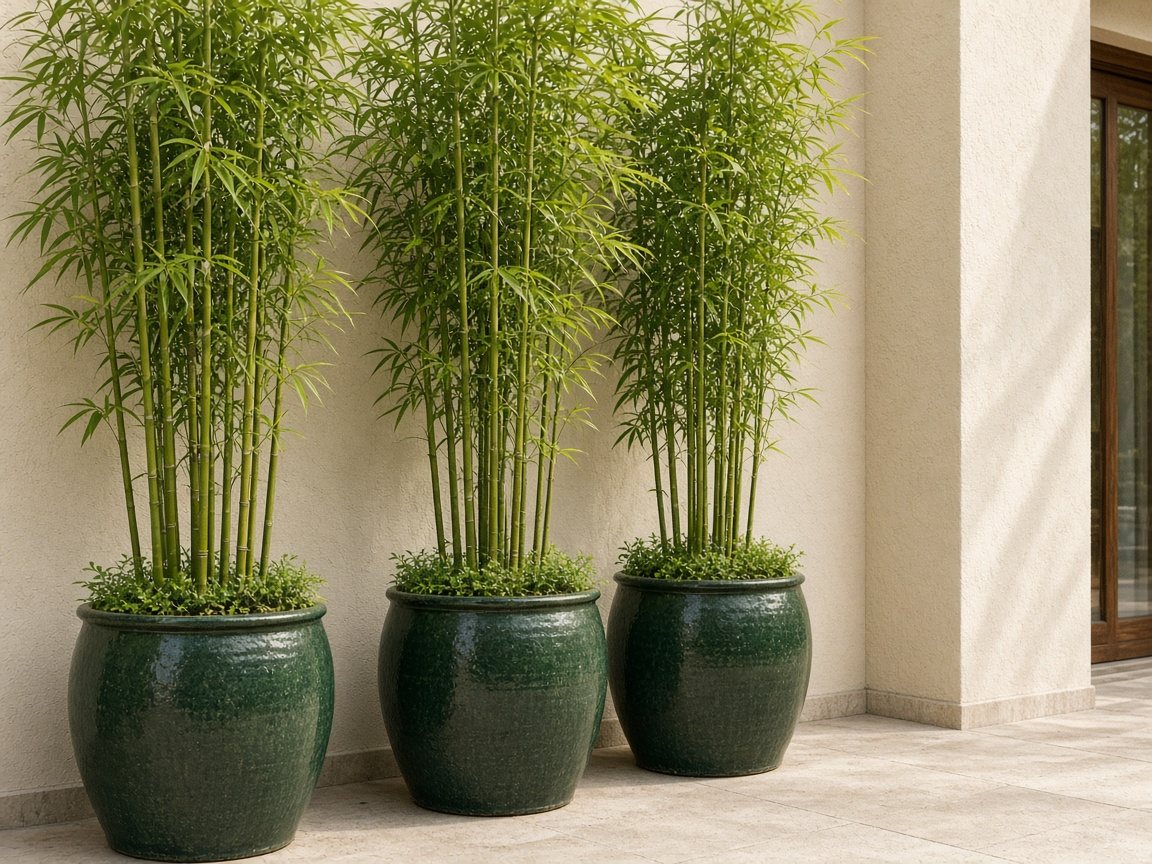
    Running bamboo growing in three large green glazed planters against a cream wall
    Big planters keep running bamboo contained on a patio (illustration).

    Option 4: Containers

    Runners can live in big containers. Pick a sturdy pot that’s at least about 2 feet across, set it where roots can’t escape through the drainage hole into the soil below, and plan to divide or repot every few years before it gets root-bound. Container plants need more water than in-ground ones.

    Already have a runaway patch?

    Start at the edges and work inward. Cut canes to the ground, dig out rhizomes, and keep snapping new shoots. Removing the leaves starves the rhizomes over time. It’s a slow job, so don’t expect one weekend to do it.

    The bottom line

    Running bamboo isn’t a mistake if you treat the barrier as part of the plant. Budget for it, install it right, and check the lip every year.

    More bamboo and sustainable living

    Save this for later

    Pin it to your garden or Sustainable Living board so it’s there when you need it.
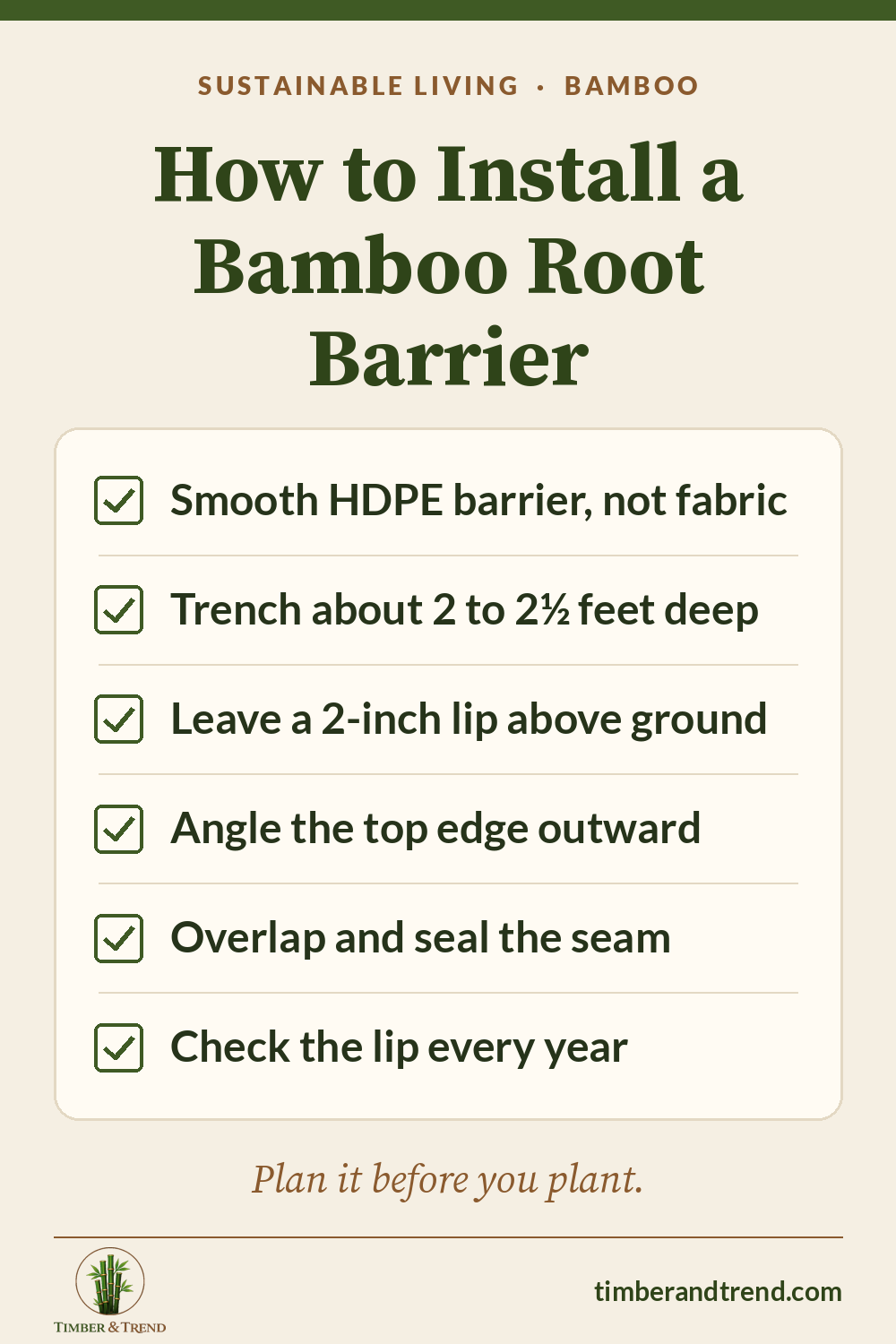
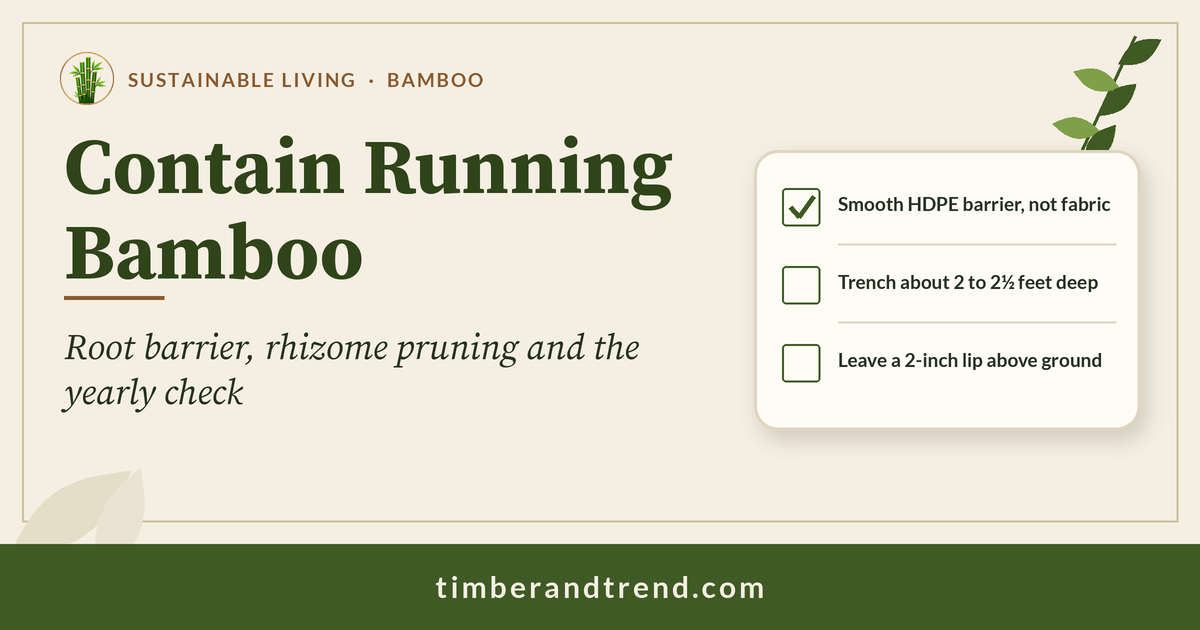
    Cream checklist pin titled How to Install a Bamboo Root Barrier with checked items: Smooth HDPE barrier, not fabric; Trench about 2 to 2½ feet deep; Leave a 2-inch lip above ground; Angle the top edge outward; Overlap and seal the seam; Check the lip every year. Footer reads Plan it before you plant.
    Home Reset Week printable bundle, $5

    Printable bundle · $5 launch price

    Get every checklist in one place

    The Home Reset Week bundle has 8 printable resets (fridge, freezer, pantry, drawers, laundry, paperwork, medicine cabinet, entryway) plus a holiday kitchen prep timeline.

  • How to Plant and Care for Clumping Bamboo (Without the Spread)

    How to Plant and Care for Clumping Bamboo (Without the Spread)

    If you want bamboo but you don’t want a war with your neighbor’s lawn, start with a clumper.

    Clumping bamboo grows in a tight, slowly widening clump. Running bamboo sends rhizomes sideways and pops up wherever it likes. Same family, very different neighbor.

    Here’s how to plant a clumper so it settles in fast, and how to keep it looking good once it does.

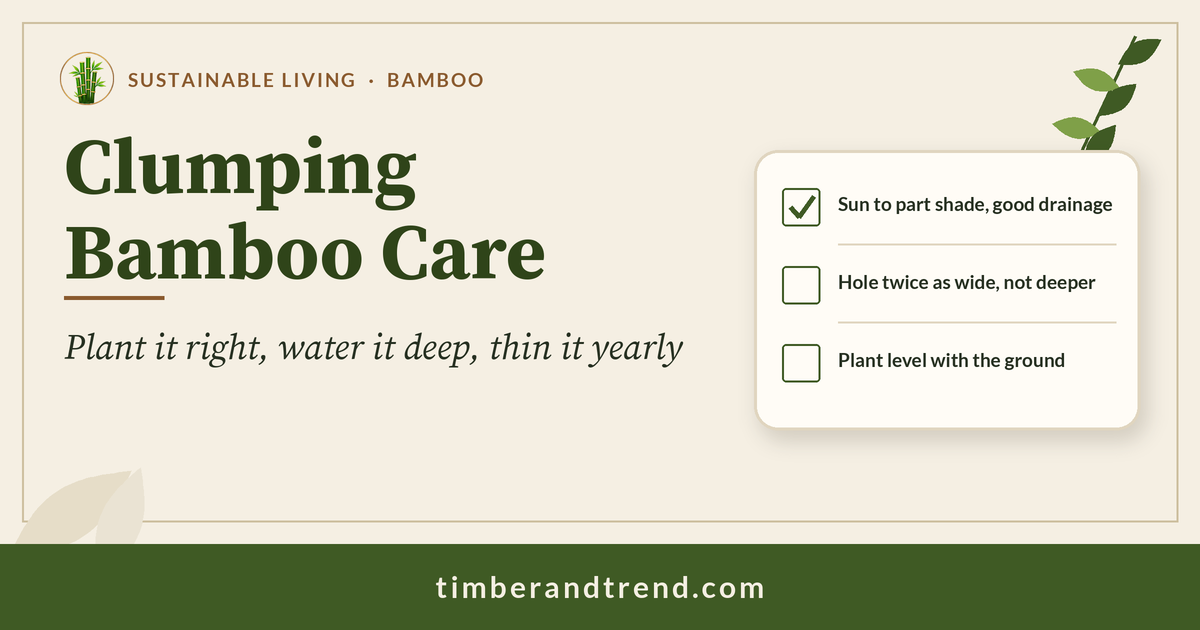
    Quick answer: Pick a spot with sun to part shade and soil that drains. Dig a hole about twice as wide as the pot and no deeper than the root ball. Plant it level with the ground, water deeply, mulch, and keep the soil evenly moist the first season. Feed in spring and early summer. Each year, cut a few of the oldest canes out at the base.

    Disclosure: As an Amazon Associate, I may earn from qualifying purchases. Some links are affiliate links and don’t cost you anything extra. Product photos and scene images are for display and inspiration only and may not show the exact item linked.

    Clumping vs. running: know which one you’ve got

    Clumping bamboos (Bambusa, Fargesia, Dendrocalamus and friends) have short, thick rhizomes that turn up into new canes close to the parent. The clump widens a little each year. It doesn’t march across the yard.

    Running bamboos (Phyllostachys, Pleioblastus, Sasa and others) have long rhizomes that travel. They need a barrier or regular rhizome pruning. If that’s what you have, read how to contain running bamboo.

    Check the botanical name on the tag. “Bamboo” alone tells you nothing.

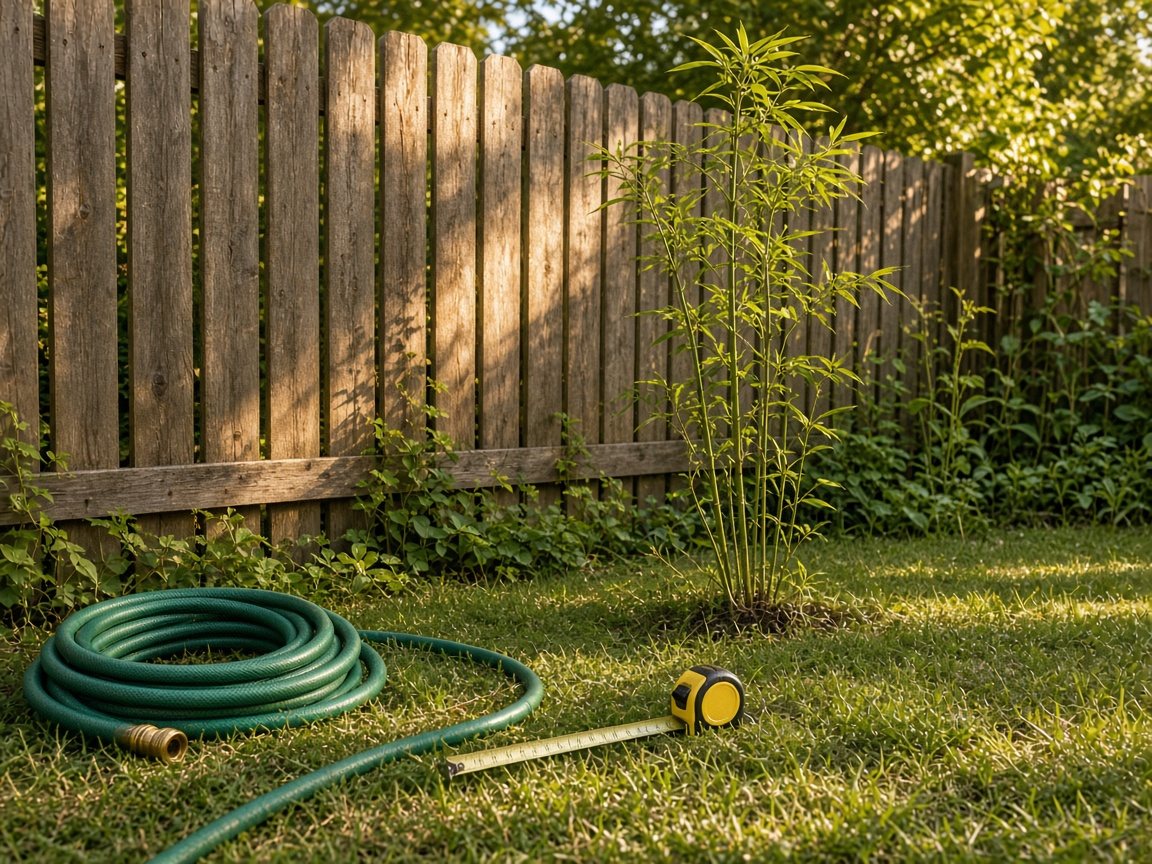
    Young bamboo planted a few feet out from a wooden fence with a hose and tape measure on the lawn
    Measure before you dig: leave room between the clump and fences or paths (illustration).

    Choosing the right spot

    Sun and shade

    Most tropical clumpers (Bambusa) want full sun to part shade. The cold-hardy clumpers (Fargesia) are the opposite. They sulk in hot afternoon sun and do best with some shade, especially in warm summers.

    Soil

    Bamboo wants soil that holds moisture but never sits wet. Skip low spots that flood and ground that’s packed hard. More on that in the bamboo soil guide.

    Space

    “Clumping” doesn’t mean small. Depending on the species, a mature clump can be anywhere from about 10 feet tall to well over 40, and several feet across. Look up the mature height and spread for your exact variety and plant for that, not for the pot it came in.

    Give it a few feet of clearance from fences, foundations and paths so you can get in to prune.

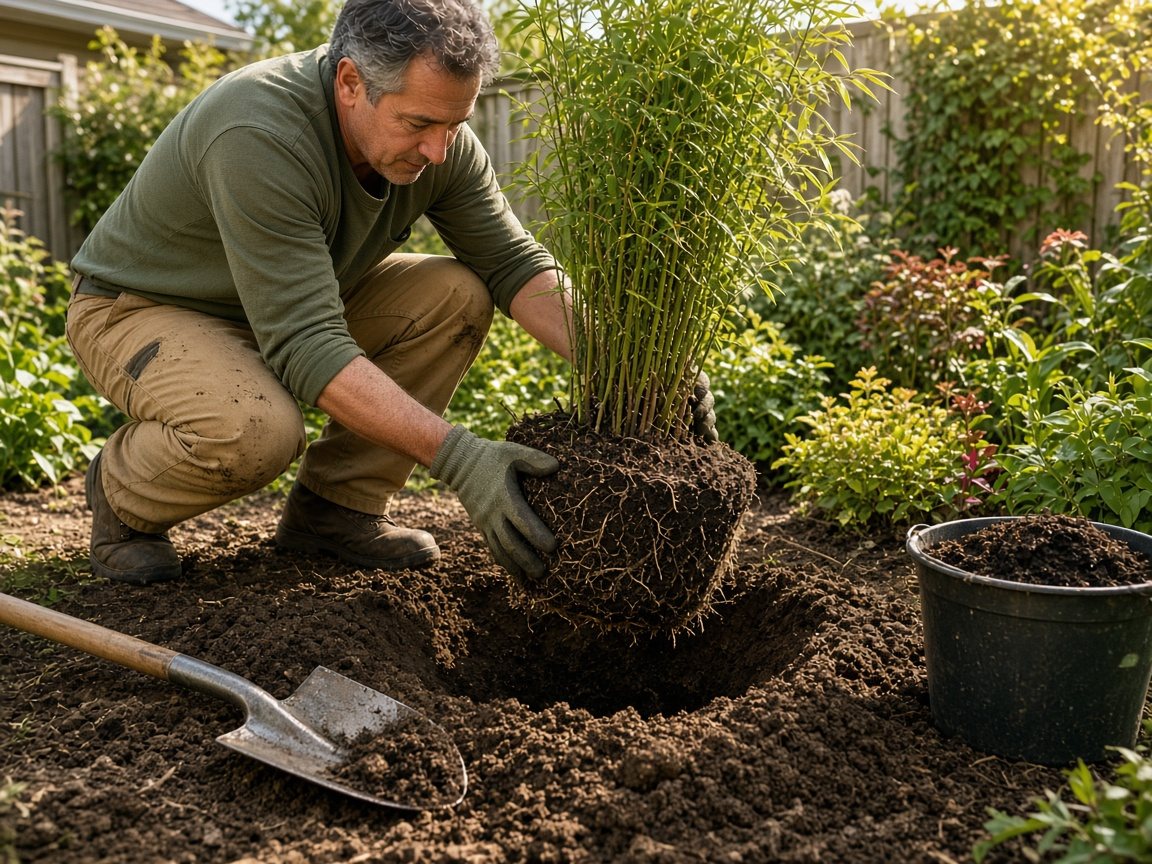
    Gardener lowering a bamboo root ball into a wide planting hole with compost nearby
    Dig wide, set the root ball at the same depth it grew in the pot, and backfill with compost-amended soil (illustration).

    How to plant clumping bamboo

    1. Water the pot a few hours before you plant.
    2. Dig a hole about twice as wide as the root ball and about as deep. Not deeper. You want the plant sitting at the same level it was in the pot.
    3. Loosen the soil around the sides of the hole and mix in some compost.
    4. Ease the plant out. If roots are circling hard, tease a few loose. Don’t hack the rhizomes.
    5. Set it level with the surrounding soil, backfill, and firm it gently with your hands to close air pockets.
    6. Water deeply until the whole root zone is soaked.
    7. Mulch 2 to 3 inches deep, keeping it a little off the canes.

    Spring is the easy season to plant in most places. In mild climates, early fall works too, as long as you can keep up with watering.

    Tidy clump of clumping bamboo with a ring of bark mulch around the base
    A mulch ring holds moisture and keeps the clump looking tidy (illustration).

    Caring for clumping bamboo

    Water

    The first year is the one that matters. Keep the soil evenly moist, not soggy. Water deeply and let the top inch or two start to dry before the next round. The 6-month watering schedule for new bamboo walks through it week by week.

    Not sure whether the top couple of inches have dried out? A simple soil moisture meter takes the guesswork out of when to water.

    As an Amazon Associate, I may earn from qualifying purchases.

    Once it’s established, a clumper still appreciates a deep soak in dry spells.

    A soaker hose laid around the clump delivers that slow, deep soak at the roots without flooding the bed.

    As an Amazon Associate, I may earn from qualifying purchases.

    Feeding

    Bamboo is a grass, and like your lawn it likes nitrogen. A balanced or nitrogen-leaning slow-release fertilizer in spring and early summer is plenty. Follow the label. Compost spread on top every spring does a lot of quiet work too.

    Don’t feed late in the season in cold areas. Soft new growth going into frost is no help.

    Leaf drop is normal

    Bamboo is evergreen, but it swaps out old leaves, mostly in spring. A carpet of yellow leaves under a clump that’s also pushing new growth isn’t a problem. Leave them. They’re free mulch.

    Pruning

    This is where clumpers go from “nice” to “wow.”

    • Thin the oldest canes. Every year or so, cut a few of the oldest, dullest canes right at ground level. It opens the clump and shows off the good ones.
    • Take out anything dead or broken at the base.
    • Topping: if you cut a cane partway up, that cane will never grow taller. It’ll bush out with more branches from the nodes below. Cut just above a node so you don’t leave a dead stub.
    • Lift the skirt. Removing low branches on the outer canes gives that clean, tropical look and makes the clump easier to walk past.

    Use clean, sharp loppers for thin canes and a fine-tooth pruning saw for thick ones.

    Common mistakes

    • Planting too deep. It slows everything down.
    • Assuming “bamboo” means clumping. Check the species.
    • Shallow, frequent sprinkles. Water deeply, less often.
    • Buying for the pot size. Buy for the mature size.

    The short version

    Right plant, right spot, good drainage, deep water the first year, a spring feed, and a yearly thinning. That’s the whole job. Clumping bamboo really is one of the lower-drama ways to get a living screen.

    More bamboo and sustainable living

    Save this for later

    Pin it to your garden or Sustainable Living board so it’s there when you need it.
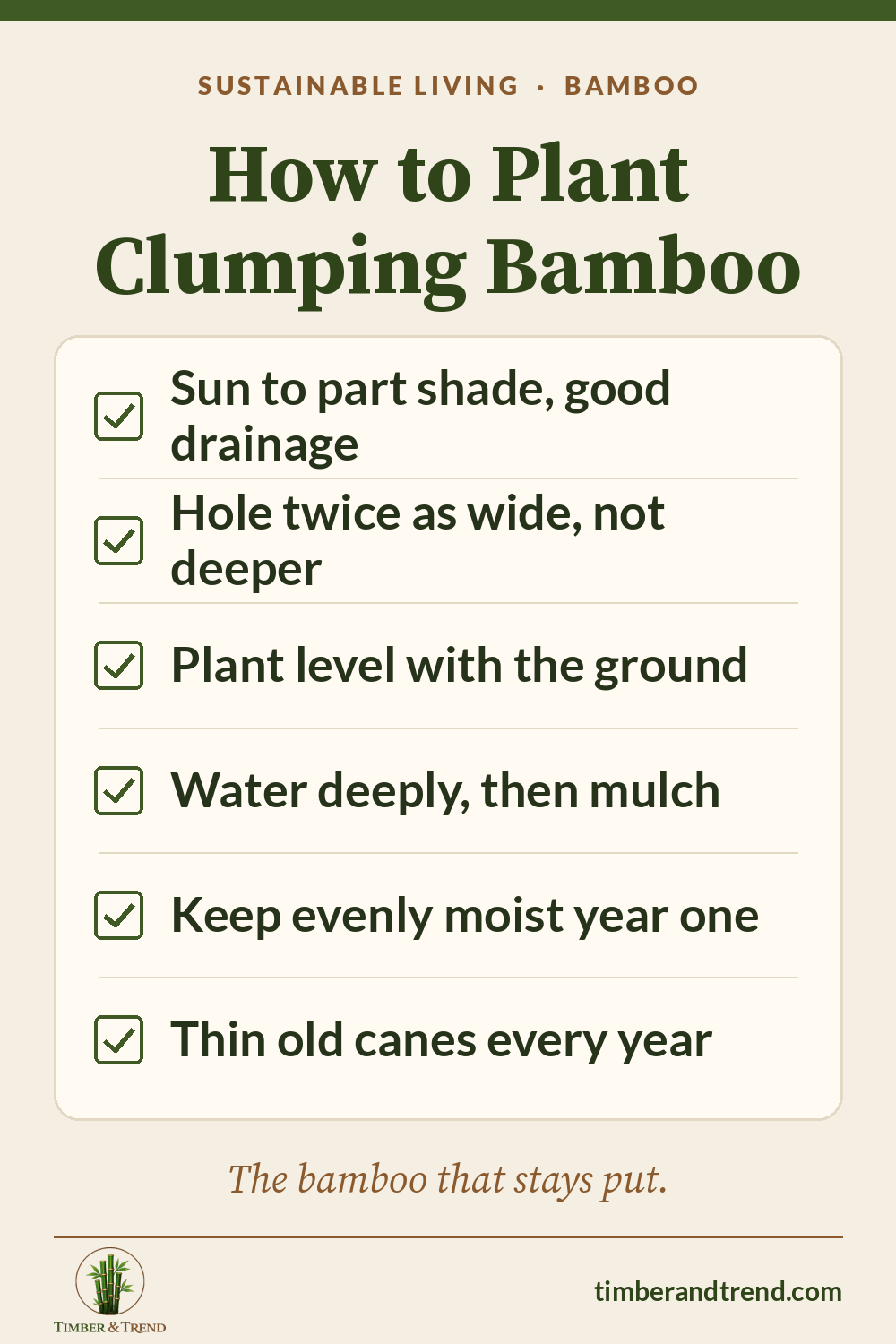
    Cream checklist pin titled How to Plant Clumping Bamboo with checked items: Sun to part shade, good drainage; Hole twice as wide, not deeper; Plant level with the ground; Water deeply, then mulch; Keep evenly moist year one; Thin old canes every year. Footer reads The bamboo that stays put.
    Home Reset Week printable bundle, $5

    Printable bundle · $5 launch price

    Get every checklist in one place

    The Home Reset Week bundle has 8 printable resets (fridge, freezer, pantry, drawers, laundry, paperwork, medicine cabinet, entryway) plus a holiday kitchen prep timeline.