
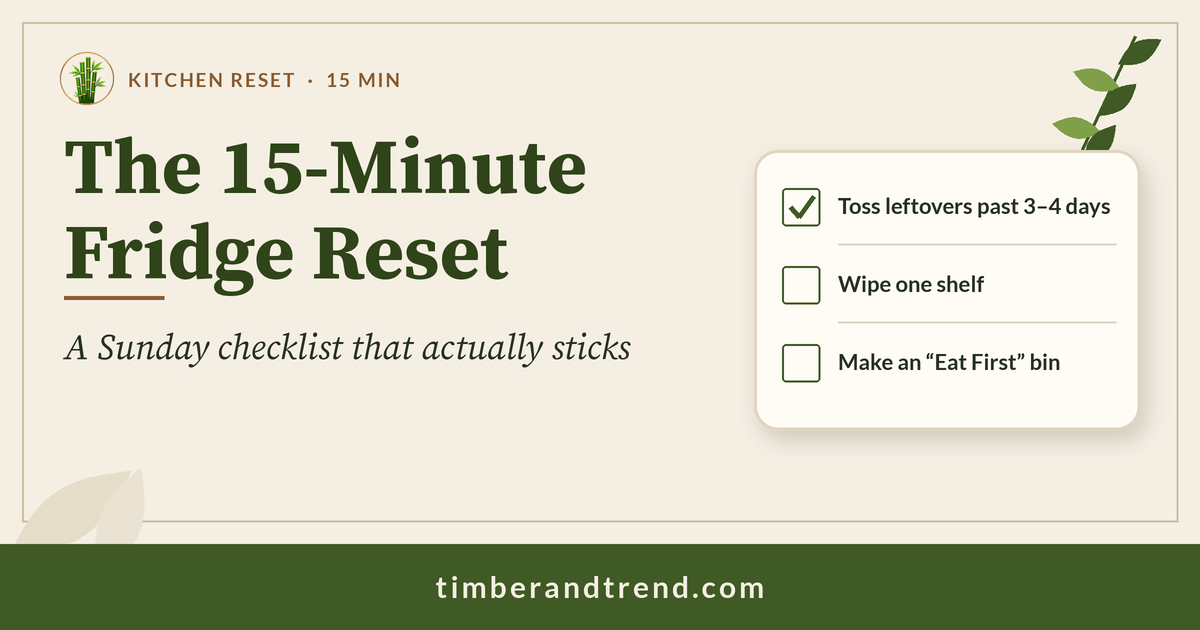
Most fridge organizing advice starts with buying a dozen clear bins. This one starts with a timer. A fridge reset is a short, repeatable routine: clear out what’s past its time, wipe one shelf, and put things back where they belong. Do it the night before you shop and you’ll buy less, waste less, and actually see what you have.
The first reset takes about 45 minutes. After that, 15 minutes a week keeps it there.
Free printable: The Reset Week Starter gives you a 7-day reset calendar so the fridge gets its own slot in the week. Download it free
Why a weekly reset beats a big clean-out
A once-a-year deep clean feels great for about ten days. Then leftovers pile up again, the back of the shelf turns into a mystery zone, and you’re buying a second jar of mustard. A small weekly reset works better because:
- It’s short enough that you’ll actually do it.
- It catches leftovers before they turn, not after.
- It lines up with shopping, so your list is built from what’s really missing.
Step 1: Clear out (5 minutes)
Pull out every leftover container and check it. A useful rule from FoodSafety.gov: cooked leftovers, soups, stews, and pizza keep about 3 to 4 days in the fridge. If you can’t remember when you made it, that’s your answer.
While you’re there, check the usual suspects:
- Opened lunch meat or deli slices: 3 to 5 days.
- Opened hot dogs: about 1 week.
- Bacon: about 1 week.
- Prepared salads (egg, chicken, tuna, macaroni): 3 to 4 days.
Toss spoiled produce and empty containers. Anything that’s still good but needs eating soon goes into one spot: your Eat First shelf or bin.
Step 2: Wipe one zone (5 minutes)
You don’t need to scrub the whole fridge every week. Wipe the shelf you just emptied, then do a quick pass on anything sticky: the crisper drawers, door shelves, and the handle. Rotate which shelf gets the full wipe so the whole fridge gets covered every month or so.
A washable shelf liner makes this faster, since you can pull it out and rinse it instead of wiping around jars.
Step 3: Check the temperature (30 seconds)
Your fridge should be at 40°F (4°C) or below, and the freezer at 0°F (-18°C) or below. The dial on many fridges is just numbers, not degrees, so an inexpensive fridge thermometer is the only way to really know. Check it once now, then every month or so.
Step 4: Put things back by zone (5 minutes)
Zones mean you stop moving five things to find one. A simple setup:
- Top shelf: ready-to-eat food. Leftovers, drinks, and the Eat First bin.
- Middle shelf: dairy and eggs. Keep eggs in their carton on a shelf, not in the door, since the door is the warmest spot.
- Bottom shelf: raw meat, poultry, and fish, on a tray or in a bin so nothing drips onto other food.
- Crisper drawers: one for vegetables, one for fruit.
- Door: condiments, juice, and butter, which handle the temperature swings best.
You don’t need matching containers for this. Use what you have; a baking tray works fine as a raw-meat catch tray.
Step 5: Write two lines before you shop
This is the step that makes the reset pay off. Before you close the door, write down:
- What’s running low. That’s the start of your shopping list.
- Two meals built around the Eat First items. That’s how the “use it up” shelf actually gets used.
Labels help here too. If you date leftovers when they go in, Step 1 next week takes half the time. Masking tape and a marker are enough; dry-erase labels are nice if you want something reusable.
How long does food last in the fridge?
These times are for a fridge at 40°F (4°C) or below, from the FoodSafety.gov Cold Food Storage Chart:
| Food | Fridge |
|---|---|
| Cooked meat or poultry leftovers | 3–4 days |
| Soups and stews | 3–4 days |
| Pizza | 3–4 days |
| Egg, chicken, tuna, or macaroni salad | 3–4 days |
| Lunch meat, opened or deli-sliced | 3–5 days |
| Hot dogs, opened | 1 week |
| Bacon | 1 week |
| Hard-cooked eggs | 1 week |
| Raw eggs in shell | 3–5 weeks |
| Raw ground meat or ground poultry | 1–2 days |
| Raw chicken or turkey | 1–2 days |
| Raw steaks, chops, roasts | 3–5 days |
| Raw fish | 1–3 days |
When in doubt, throw it out. These charts are guidelines, and smell isn’t a reliable test.
Common fridge reset mistakes
- Organizing before purging. Clear out first, or you’re just arranging old food more neatly.
- Buying containers first. Live with your zones for two weeks, then buy only what you’re missing.
- Overpacking. Cold air needs room to move; a crammed fridge cools unevenly.
- Skipping the list. The reset only saves money if it changes what you buy.
Make it a routine
Pick one night, ideally the night before your usual shopping day, and attach the reset to something you already do, like running the dishwasher after dinner. Set a 15-minute timer and stop when it goes off. Next week, you’ll be faster.
If you’re doing the freezer too, our freezer inventory guide pairs with this, and the Weekly Home Reset Routine shows how the fridge fits into the rest of the week. The pantry reset uses the same zones-before-containers rule for dry goods, and if your grocery list lives on paper, the monthly Paperwork Hour is a good home for the rest of your lists.
Get the free printable
The Reset Week Starter is a free two-page PDF: a 7-day reset calendar that gives the fridge its own slot, plus a freezer inventory sheet. Download it free
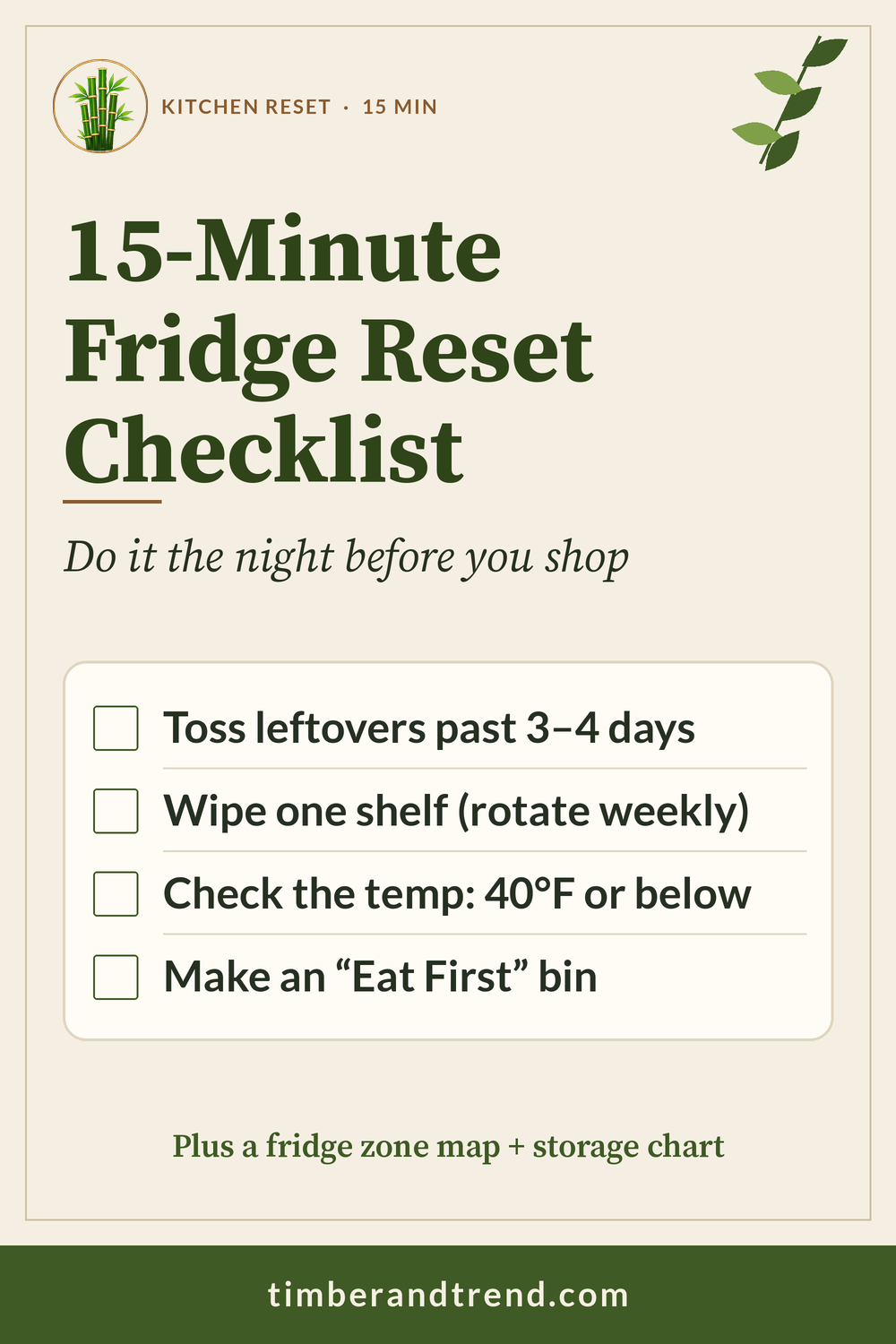
Save this for later
Pin it to your home or cleaning board so the checklist is there on reset day.
Printable bundle · $5 launch price
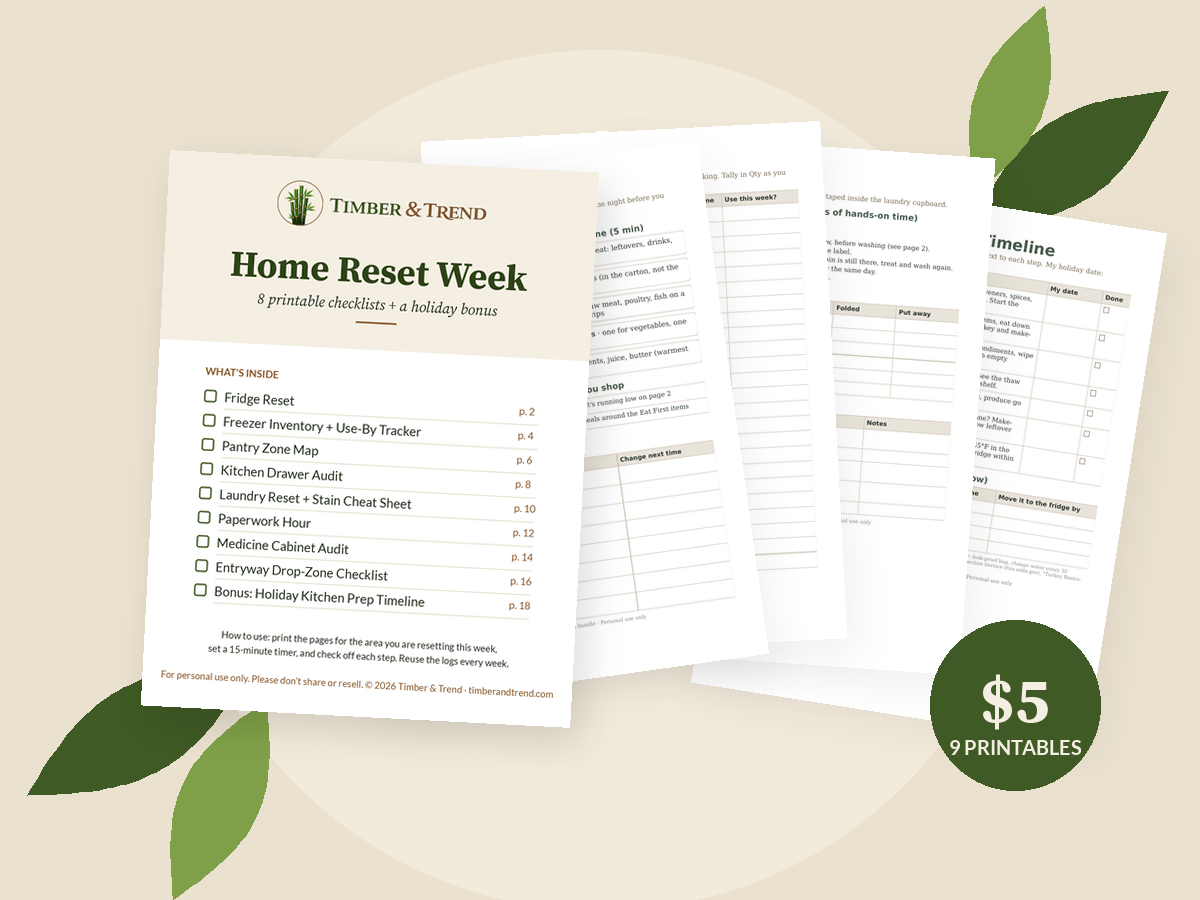
Get every checklist in one place
The Home Reset Week bundle has 8 printable resets (fridge, freezer, pantry, drawers, laundry, paperwork, medicine cabinet, entryway) plus a holiday kitchen prep timeline.