

Bamboo isn’t one plant. It’s a whole subfamily of grasses, well over a thousand species sorted into more than a hundred genera.
You don’t need to know them all. But knowing the handful you’ll actually meet tells you the two things that matter most: whether it runs, and what climate it wants.
Quick answer: Phyllostachys and Pleioblastus are runners. Bambusa, Fargesia, Dendrocalamus, Gigantochloa, Guadua and Chusquea are clumpers (Guadua and some Chusquea grow in looser, more open clumps). Fargesia is the cold-hardy clumper. Bambusa, Dendrocalamus, Gigantochloa and Guadua are warm-climate bamboos.
Phyllostachys (running)
The most common bamboo in temperate gardens, native to China and nearby.
- How to spot it: a groove up one side of the cane above the branches, and branches in pairs.
- Habit: running. Needs containment.
- Hardiness: many are fairly cold-tolerant.
- Examples: Moso (P. edulis), the big timber and edible-shoot bamboo of China; golden bamboo (P. aurea); black bamboo (P. nigra); Japanese timber bamboo (P. bambusoides); yellow groove (P. aureosulcata), one of the cold-hardier ones.
Bambusa (clumping)
A big genus of tropical and subtropical clumpers from Asia. This is where most of the popular hedge and screen bamboos live.
- Habit: clumping. It doesn’t send rhizomes off across the yard.
- Hardiness: warm climates. Most are listed for zones 8 or 9 and up.
- Examples: Alphonse Karr and Golden Goddess (B. multiplex), weaver’s bamboo (B. textilis), giant timber bamboo (B. oldhamii), Buddha Belly (B. ventricosa), and common bamboo (B. vulgaris).
See the clumping bamboo varieties guide for sizes.
Fargesia (clumping, cold-hardy)
Mountain bamboos from China, and the go-to clumpers for cold climates.
- Habit: clumping, often with a soft, arching, fountain shape.
- Hardiness: many handle much colder winters than any Bambusa.
- Needs: shade from hot afternoon sun. They dislike hot, humid summers.
- Examples: fountain bamboo (F. nitida), umbrella bamboo (F. murielae).
Dendrocalamus (clumping, giant)
Some of the largest bamboos on earth, from tropical Asia.
- Habit: clumping. Despite what you’ll read in some places, these aren’t runners.
- Size: the biggest can top 80 feet with very thick canes.
- Uses: construction, and some (like D. asper) are grown for edible shoots.
- Examples: giant bamboo (D. giganteus), D. asper, and D. strictus, which is often called male bamboo and can have nearly solid canes.
Gigantochloa (clumping)
Tropical clumpers from Southeast Asia, used for building, crafts and food.
- Example: Tropical black (G. atroviolacea), with dark purple-black canes. More in the black bamboo guide.
Guadua (clumping, open)
The great bamboos of Central and South America.
- Habit: clumping, but in a looser, more open clump than Bambusa.
- Uses: Guadua angustifolia is one of the most important construction bamboos in the world, especially in Colombia and Ecuador.
- Watch out for: many have thorny branches.
Chusquea (mostly clumping)
A large genus from Central and South America, especially the Andes.
- How to spot it: unlike most bamboos, Chusquea canes are usually solid, not hollow.
- Examples: Chusquea culeou, a cold-tolerant species from Chile and Argentina.
Pleioblastus (running)
Mostly small, running bamboos from Japan and China, often used as ground cover.
- Habit: running, sometimes aggressively for their size.
- Example: dwarf greenstripe (P. viridistriatus), a knee-high bamboo with yellow-and-green striped leaves. It’s often wrongly listed as a clumper.
A quick cheat sheet
- Runner: Phyllostachys, Pleioblastus (also Sasa).
- Cold-hardy clumper: Fargesia.
- Warm-climate clumper: Bambusa, Gigantochloa, Dendrocalamus.
- New World bamboos: Guadua, Chusquea.
Want to figure out what’s in your yard? Try these clues for identifying bamboo.
More bamboo and sustainable living
- How to Identify Bamboo: 7 Clues to Tell Species Apart
- Black Bamboo Varieties: Running and Clumping Types Compared
- Clumping Bamboo Varieties: 12 Popular Types Compared
- Everything in Sustainable Living
Save this for later
Pin it to your garden or Sustainable Living board so it’s there when you need it.

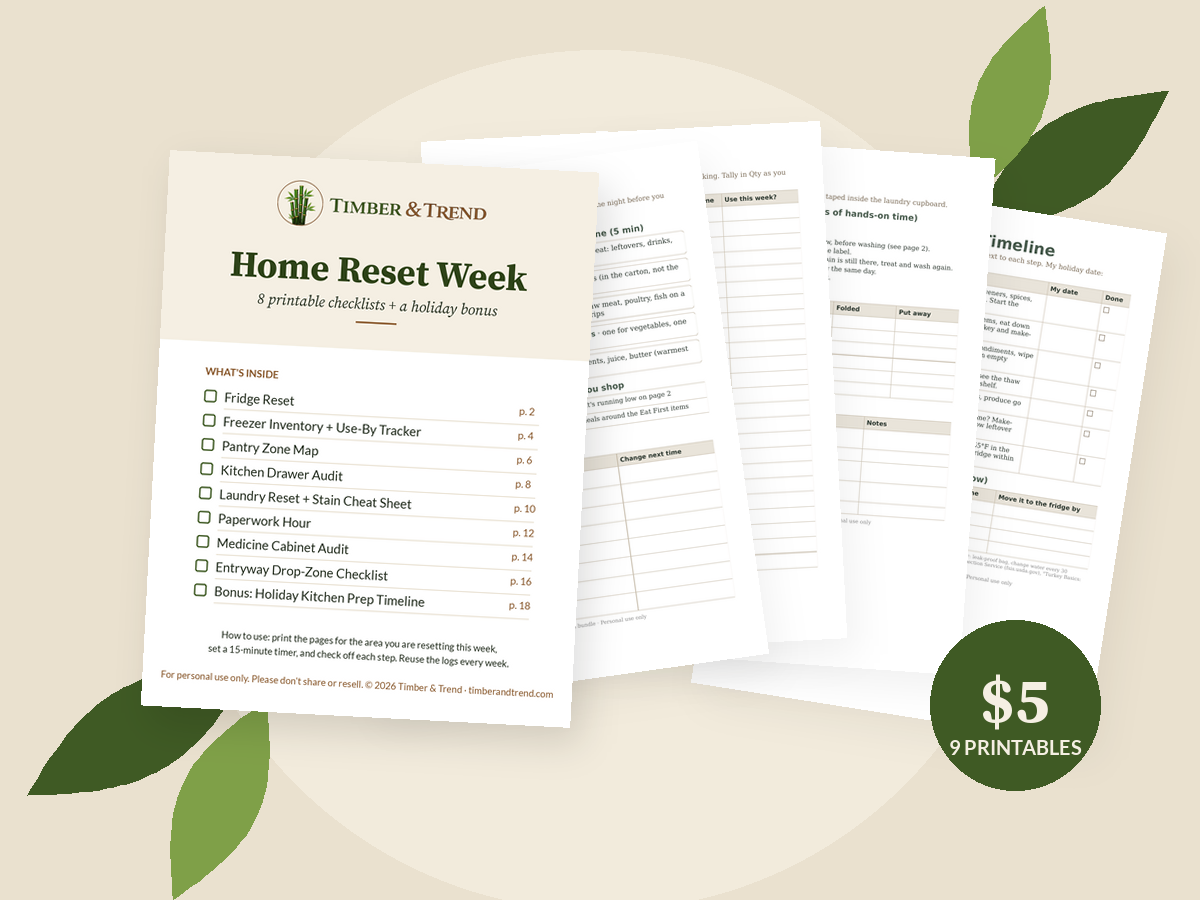
Printable bundle · $5 launch price
Get every checklist in one place
The Home Reset Week bundle has 8 printable resets (fridge, freezer, pantry, drawers, laundry, paperwork, medicine cabinet, entryway) plus a holiday kitchen prep timeline.