

Black Friday is this Friday, Nov 27. Cyber Monday is Nov 30. The deals show up before most of us have even decided who’s on the list this year, and that’s exactly how a “few things for the kids” turns into a January credit card bill.
The fix isn’t fancy. It’s a list of names with a number next to each one, written down before you open a single sale email. This guide walks you through setting a total you can actually afford, splitting it by person, shopping the deal days without getting talked into extras, and tracking what you spend as you go. There’s a free two-page printable at the end with the gift list, the budget math and a deal-day sheet.
Free printable · 2 pages · no email needed
Gift List and Budget Planner
Page one is the budget math and a gift list with columns for the idea, the budget, what you paid and the return date. Page two is a deal-day sheet for Black Friday and Cyber Monday, a gift card log, the 2026 USPS ship-by dates and an after-Christmas notes box.
Affiliate disclosure: This post contains affiliate links. As an Amazon Associate, I earn from qualifying purchases, so if you buy through one of these links I may earn a commission at no extra cost to you. The scene and stock images in this post are for display and inspiration only and may not show the exact items linked.
The short version
- Pick the total first. Bills come out before gifts do. The gift number is whatever’s left after that.
- Take the extras off the top. Wrapping, cards, postage, holiday food and travel all come out of the same pot.
- Write the names, then a number by each one. Not the other way around.
- Shop the list, not the sale. If it isn’t on the list, it doesn’t go in the cart.
- Write down what you actually paid, every time, plus the last day to return it.
- Mail early. USPS says Dec 17 for Ground Advantage and First-Class Mail to arrive by Christmas in the lower 48.
Why a number by every name matters
Prices are on everyone’s mind this year. In the National Retail Federation’s 2026 holiday survey, 56 percent of holiday shoppers said the economy will affect their spending plans. Among them, 43 percent plan to shop for sales more often and 31 percent will comparison shop online more often.
What NRF didn’t publish this year is an average dollar amount per person. Its FAQ says the 2026 survey focuses on shopping behaviors instead. The last figure it put out, in 2025, was about $628 per person planned for gifts for family and friends, out of about $890 for the whole season. That’s an average, not a target. Your number comes from your own budget, not anyone else’s.
Here’s the honest reason to write it down. The FDIC points out that sales can lead to impulse buying and overspending, especially on things that weren’t on your list to begin with. A total in your head bends. A number next to a name on paper doesn’t bend nearly as easily.
The Consumer Financial Protection Bureau suggests one personal rule that does a lot of the work for you: if something isn’t on your list, don’t buy it. That’s the whole system, really. The rest of this post just makes the list good enough to trust.

Step 1: Set the total before you think about gifts
Start with your regular month, not with the gifts. The CFPB’s holiday spending plan says to account for your typical bills first, then estimate anything extra coming up, like hosting or traveling to see family. Whatever is left after that is what you can spend on gifts.
South Dakota State University Extension adds a smart starting point: look at what you spent last holiday season. Did it feel right, or did it follow you around all year? Use that as your baseline and adjust from there.
Then decide where the money is actually coming from. A savings envelope, a few paychecks, a category you’ll trim for a month. If you can’t point to it, the number’s too high.
Step 2: Take the extras off the top
This is where holiday budgets quietly leak. SDSU Extension’s list of things to budget for includes wrapping paper, bows, gift bags, tape, postage and cards. Mississippi State University Extension adds greeting cards, gatherings, travel, office parties, holiday groceries and charitable donations.
So before you split anything by person, write those lines down and give each one a number. A simple example:
- Total for the season: $600
- Extras (wrap, cards, postage, a hostess gift, holiday baking): $90
- Left for gifts: $510
Now $510 is your gift number, not $600. It feels smaller. It’s also real.

If you’re hosting Thanksgiving or Christmas, the food side has its own plan in the Thanksgiving kitchen prep checklist and the holiday baking pantry check, which helps you skip buying a second jar of something you already have.
Step 3: Write the names, then the numbers
The FDIC suggests listing everyone you intend to shop for, family, friends, coworkers and others, along with what you plan to buy and how much you’ll spend on each. SDSU Extension puts it more bluntly, and I love this line: think about who you want to give gifts to, not who you feel you need to.
Once the names are down, sort them into a few rough groups so the numbers make sense:
| Group | Who usually lands here | How to set the number |
|---|---|---|
| Inner circle | Partner, kids, parents | The biggest share of the gift number |
| Close | Siblings, best friends, grandkids | A set amount each, the same for everyone in the group |
| Small thanks | Teachers, neighbors, the mail carrier | One small, consistent gift, often homemade |
| Group gift or name draw | Extended family, coworkers | One gift per person through a draw, or a shared gift |
Add up the column. If it’s over your gift number, trim now, on paper, where it costs nothing. It’s a lot easier to cross out a line in November than to return a sweater in January.
Step 4: One idea per person, then check the price
Next to each name, write one gift idea. Just one. Then look up what it actually costs. SDSU Extension recommends researching prices so you know the amount you’ve set is realistic, and thinking about what the person actually needs, like a replacement for something worn out.
If an idea doesn’t fit the number, change the idea, not the number. The low-waste holiday gift ideas guide is full of gifts that get used up or used for years, and a lot of them cost very little.
Step 5: Fewer gifts is allowed
You don’t have to buy for everyone you bought for last year. Mississippi State University Extension suggests drawing names with family and friends, or pooling gift money for a group donation. It also suggests thoughtful, practical gifts like homemade food or kitchen supplies.
Homemade food gifts are honestly the best deal on the list. A batch of frozen cookie dough turns into a dozen small gifts, and shipping cookies is easier than it sounds. A real card with a few handwritten lines counts too, and writing Christmas cards doesn’t have to take a whole weekend.
Black Friday and Cyber Monday: shop the list, not the sale
Deal days are great if you walk in with a list. They’re a trap if you don’t. Before Friday, copy every planned gift onto one sheet with four things next to it: the person, the most you’ll pay, the stores you’ll check and the return window.
- Set a ceiling price for each item. If it doesn’t hit that number, you’re not missing anything. You’ll buy it later at the price you planned.
- Compare a few stores. The FDIC recommends comparing prices across stores and online retailers before you buy.
- Check the return window before you check out. Every store sets its own rules, and they can change for holiday orders. Write the last return date on your list right away.
- Skip the “while you’re here” stuff. That’s the impulse buying the FDIC warns about.
How you pay matters, too
The CFPB lays out the trade-off plainly. Bringing only the cash you plan to spend keeps you inside your limit, because once it’s gone, you’re done. Mississippi State University Extension agrees that it’s easier to overspend with credit.
A credit card does give you more consumer rights if something arrives broken, the CFPB notes. If you use one, have a plan to pay the bill in full. The Federal Reserve’s latest consumer credit report puts the average rate on credit card accounts that were charged interest at 22.36 percent in the third quarter of 2026. That turns a deal into a not-deal fast.
Buy now, pay later deserves a careful look before Friday. The CFPB warns that most of these loans charge late fees, that you may have to keep making payments even after you return an item while the return is sorted out, and that they don’t carry the same dispute protections as credit cards if the item is faulty or a scam. If you use one, write the payment dates on your list next to the gift.
Gift cards
Gift cards are the top item on wish lists again. In NRF’s 2026 survey, 47 percent of people said they’d like to receive one. A few rules make them a safer gift:
- Under federal rules, a gift card can’t be sold with an expiration date less than five years out, according to the CFPB and the FDIC.
- Inactivity or service fees can’t be charged during the first 12 months. After that, fees can chip away at the balance, so tell the person to use it.
- Give the receipt and the terms with the card. The CFPB suggests that, and some states add extra protections.
Track it as you go
Here’s the habit that keeps the whole thing honest. The FDIC suggests checking off each gift as you buy it and recording the actual amount you spent, or saving the receipt, which also helps if you need to make a return. The CFPB’s plan ends the same way: track your holiday spending and check periodically that you’re on track.
On paper, that’s three columns next to each name: budget, paid, return by. Keep a running total at the bottom. When you’re under on one person, you know exactly how much room you have for the next. When you’re over, you see it the same day, not on the statement.
Keep the list somewhere you’ll actually have it while you shop. A pocket notebook in your bag works better than a note buried in your phone, because you can see the whole list, the numbers and the running total at once. The handwritten list system and the analog bag both explain how to make that paper habit stick.
As an Amazon Associate, I earn from qualifying purchases.
Tuck the receipts in one envelope with the list. If you keep a household binder or a paperwork system, that envelope can live there until the return windows close.

Don’t forget the ship-by dates
If any gift has to travel, put the mailing date on the list next to it. The U.S. Postal Service’s recommended 2026 send-by dates for delivery before Dec. 25 in the lower 48 are:
- USPS Ground Advantage and First-Class Mail: Thursday, Dec. 17
- Priority Mail: Friday, Dec. 18
- Priority Mail Express: Saturday, Dec. 19
- International First-Class Package and Priority Mail International: Wednesday, Dec. 9 for most regions
USPS also notes Hanukkah runs Dec. 4 to Dec. 12 this year, earlier than usual, so adjust if you’re mailing for that. Online orders have their own cutoffs, so check the store’s shipping page before you count on it.
Wrapping goes in the budget, too
Wrap is one of those small lines that adds up. Before you buy any, look at what you saved from last year. SDSU Extension suggests exactly that before replacing anything. Paper bags, maps, fabric scraps and a ball of twine go a long way, and the zero-waste gift wrapping guide shows the folds.
If you’d like one reusable wrap that keeps coming back, a small cotton furoshiki is about the size of a large napkin. It ties around a book or a small box, and the cloth becomes part of the gift.
As an Amazon Associate, I earn from qualifying purchases.

After Christmas: write down what you really spent
This is the step almost everyone skips, and it’s the one that makes next year easy. Sometime between Christmas and New Year’s, total the paid column and write three notes at the top of the list:
- What you actually spent, gifts and extras separately.
- What worked, the gifts people used, and the ideas you’d repeat.
- What to drop, the extras that crept in, and anyone who should move to a name draw.
Then fold the list into your paper planner for next year. When November comes back around, you’ll start with real numbers instead of a guess. And if the post-holiday house needs a reset once the boxes are gone, the New Year declutter checklist is the next step.
Free printable: Gift List and Budget Planner
Two pages, no email needed:
- Budget and gift list: your total, the extras taken off the top, the gift number, and a gift list with columns for the person, the idea, the budget, what you paid and the return-by date, with a running total
- Deal-day sheet: each planned buy with the most you’ll pay, stores to check and the return window, plus a gift card log, a ship-by box with the 2026 USPS dates and an after-Christmas notes box
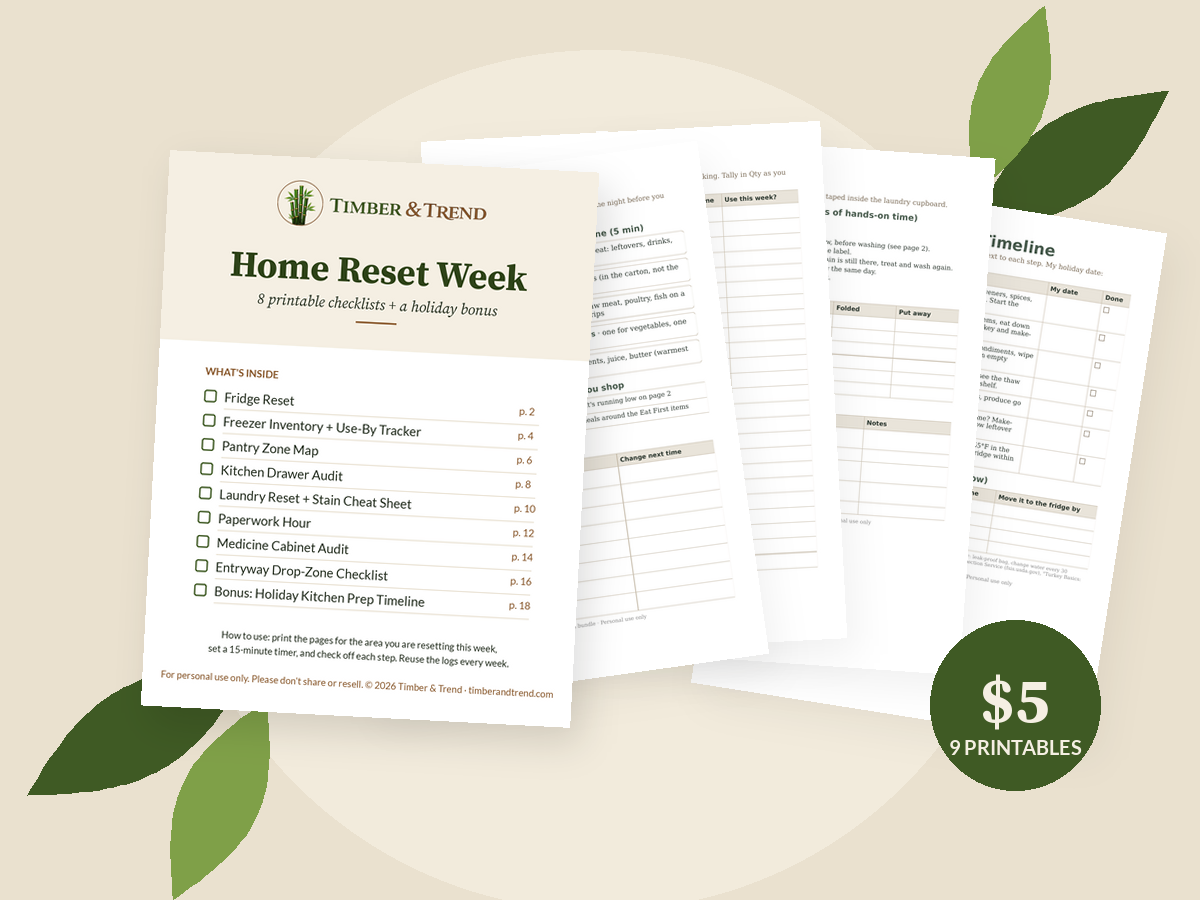
Print it, fill it in before Friday, and keep it in your bag. If you want the bigger home reset in one place before company arrives, the $5 Home Reset Week bundle has the fridge, freezer, pantry and guest-ready resets.
Related guides
- Low-waste holiday gift ideas that don’t end up in a drawer
- Zero-waste gift wrapping with furoshiki, kraft paper and wraps you already own
- Activity advent calendar: 24 low-waste December ideas
- The handwritten list system
- How to write Christmas cards
- How to ship cookies
- Guest room checklist
- Screen-free winter evenings
- More in Home Resets, Sustainable Living, Analog Life and Curated Essentials
Sources
- National Retail Federation: NRF Forecasts 2026 Holiday Sales Growth as Consumers Remain Resilient
- National Retail Federation: Affordability Shapes Winter Holiday Shopping, According to NRF Holiday Survey (2026)
- National Retail Federation: Winter Holiday FAQs
- National Retail Federation: Consumers to Spend Second-Highest Amount on Record (2025 survey)
- Consumer Financial Protection Bureau: A five-step spending plan to avoid holiday debt
- Consumer Financial Protection Bureau: Know before you buy (now, pay later) this holiday season
- Consumer Financial Protection Bureau: Unwrapping gift cards (PDF)
- FDIC Consumer News: Banking on the Holidays
- South Dakota State University Extension: Planning for Holiday Expenses on a Tight Budget
- Mississippi State University Extension: 5 Tips to Manage Holiday Spending
- Federal Reserve: Consumer Credit G.19 (released Nov. 6, 2026)
- U.S. Postal Service: 2026 Holiday Shipping Deadlines
Save this for later
Pin it to your Holiday board so the list and the numbers are ready before the Black Friday and Cyber Monday deals.

Printable bundle · $5 launch price
Get every checklist in one place
The Home Reset Week bundle has 8 printable resets (fridge, freezer, pantry, drawers, laundry, paperwork, medicine cabinet, entryway) plus a holiday kitchen prep timeline.