
Affiliate disclosure: This post contains affiliate links. If you buy through one, I may earn a commission at no extra cost to you. As an Amazon Associate I earn from qualifying purchases.
Holiday hosting has two halves. There’s the kitchen half, which gets all the attention. And there’s the half where your sister-in-law needs a pillow, a towel, a hook for her coat, and a way to find the bathroom at 2 a.m. without stubbing a toe.
This guide is the second half. It’s a guest room checklist plus a simple two-week countdown for the spots guests actually use: where they sleep, the bathroom, the entryway, and a little coffee corner. If you’ve got the food side handled, this is what’s left.
Quick answer: Start 14 days out. Settle who sleeps where and test the bed. Wash the guest linens the week before. Clear one surface and one drawer in the sleeping spot. Restock the guest bathroom and move medicines out of reach. Free up three hooks by the door. Test your smoke and CO alarms. The night before, make the bed and walk the route to the bathroom with the lights off.
Free printable · 2 pages · no email needed
Guest-Ready Countdown
A 14-day countdown with fill-in dates, room-by-room checklists for the sleeping spot, bathroom, entryway and safety walk, and a cut-out guest card for the Wi-Fi password and house notes.
Answer three questions first
Before you wash a single sheet, get these on paper:
- Who’s sleeping where, and for how many nights? One night on the couch and five nights in the guest room are different jobs.
- Anyone with extra needs? Little kids, an older relative who gets up at night, a guest with allergies, a dog that’s coming too.
- What’s the arrival day and time? Write it on the countdown. Everything else works backward from it.
That’s the whole planning meeting. Ten minutes, tops.
The 2-week countdown
Thanksgiving 2026 is Thursday, November 26. If your guests arrive Wednesday the 25th, here’s how the dates fall. Different arrival day? Count back the same way.
| When | What to do | Time |
|---|---|---|
| 14 days out (Wed, Nov 11) | Sleep plan and headcount. Set up the air mattress, sofa bed, or futon and test it. Order anything missing now. | 20 min |
| 10 days out (Sun, Nov 15) | Linen count. Wash the stored guest sheets, blankets, and towels so they don’t smell like the closet. | 1 to 2 loads |
| 7 days out (Wed, Nov 18) | Clear the sleeping spot: one surface, one drawer or shelf, empty hangers, a trash can. Test smoke and CO alarms. | 30 min |
| 5 days out (Fri, Nov 20) | Guest bathroom reset and restock. Move medicines up and away. | 20 min |
| 3 days out (Sun, Nov 22) | Entryway: clear three hooks, a shoe spot, and a place for bags. | 15 min |
| 1 day out (Tue, Nov 24) | Make the beds, set out towels, plug in night lights, put out the guest card. Do the lights-off walk. | 20 min |
| Arrival day | Ten-minute surface reset. Done. | 10 min |
The kitchen countdown runs on the same calendar. Thursday the 19th is fridge reset day in the holiday kitchen prep checklist, the day after your sleeping-spot session, so the two jobs don’t land on the same night.
Reading this late? Start with the next row and skip the ones you’ve missed. No guest is going to notice the towels weren’t washed 10 days early.
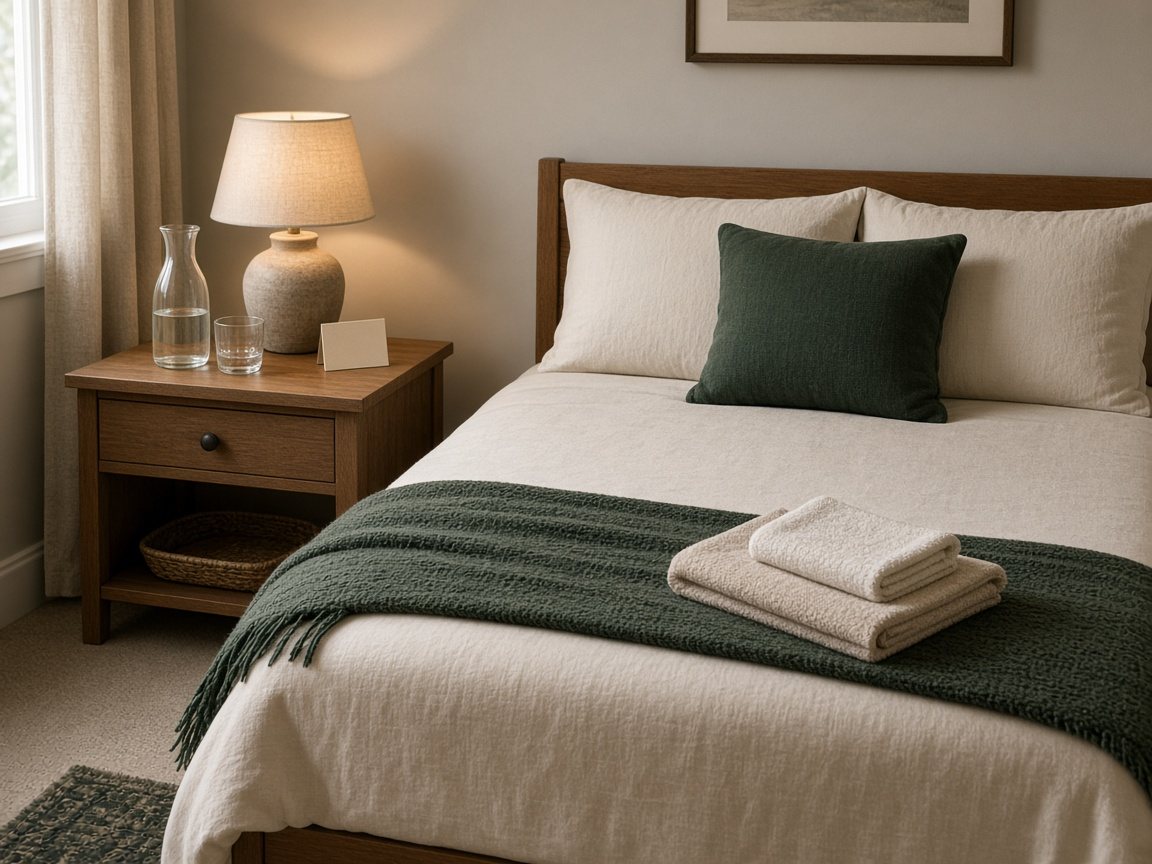
Guest room checklist (or the sleeping spot)
Most guests need less than the Pinterest-perfect guest room suggests. They need a comfortable place to sleep, a place to put their stuff, and light they can reach.
Bed and bedding
- Bed, sofa bed, or air mattress set up and tested (sleep on the air mattress for an hour if you can stand it; slow leaks show up overnight)
- Clean sheets and pillowcases on the bed
- One extra blanket where they can see it, folded at the foot of the bed
- Two pillows per person if you have them
Space for their things
- One cleared surface for a phone, glasses, and a water glass
- One empty drawer, shelf, or basket for clothes
- Four or five empty hangers
- A spot for the suitcase that isn’t the walkway
- A small trash can
Light and comfort
- A lamp or light switch they can reach from bed
- A night light between the bed and the bathroom
- A spare phone charger or a power strip near the bed
- Curtains that close, or a spare blanket you can pin up over a bright window
The National Institute on Aging’s room-by-room fall prevention list says to put night lights and light switches close to the bed and keep a flashlight by the bed in case the power goes out. That’s worth doing for any guest, and it matters most for older relatives sleeping in a room they don’t know. (NIA: Preventing Falls at Home)
If the guest room doubles as your office or paper drop zone, don’t sort it all now. Box the loose papers, label the box “Paperwork Hour,” and deal with it after the holiday with the Paperwork Hour system.
No guest room? Make a sleeping spot
A couch, a corner of the living room, or a kid’s room can all work. What turns a couch into a guest spot:
- A folding screen, a bookcase, or even a closed door to the hallway for a little privacy
- A basket next to the couch holding their sheets, blanket, pillow, and towel, so they can make up the bed when they’re ready
- A clear plan for when the room goes quiet at night and who’s up first in the morning
- One chair or stool to use as a nightstand
Sleeping in a room that usually isn’t a bedroom changes the safety math. The U.S. Fire Administration says smoke alarms belong inside and outside each bedroom and sleeping area (USFA), so if the living room becomes one for a week, check that there’s a working alarm nearby. More on that in the safety walk below.
Linens: what you actually need
Pull out every guest sheet set and towel and count. Here’s my rule of thumb, not a law:
- Sheets: one set per bed, plus one spare set if guests are staying more than a few nights or there are little kids
- Towels: one bath towel and one hand towel per guest, plus a washcloth if they’re the washcloth type
- Blankets: one extra per sleeper, especially in a room that’s usually cooler than the rest of the house
Stored bedding picks up that closet smell. Wash it about 10 days out, dry it completely, and fold it straight into a basket for each sleeping spot. Your weekly laundry reset can absorb these loads if you plan them in.
Short on towels? Borrow from your own stash and wash yours mid-visit. Don’t buy a whole new matching set for four nights.
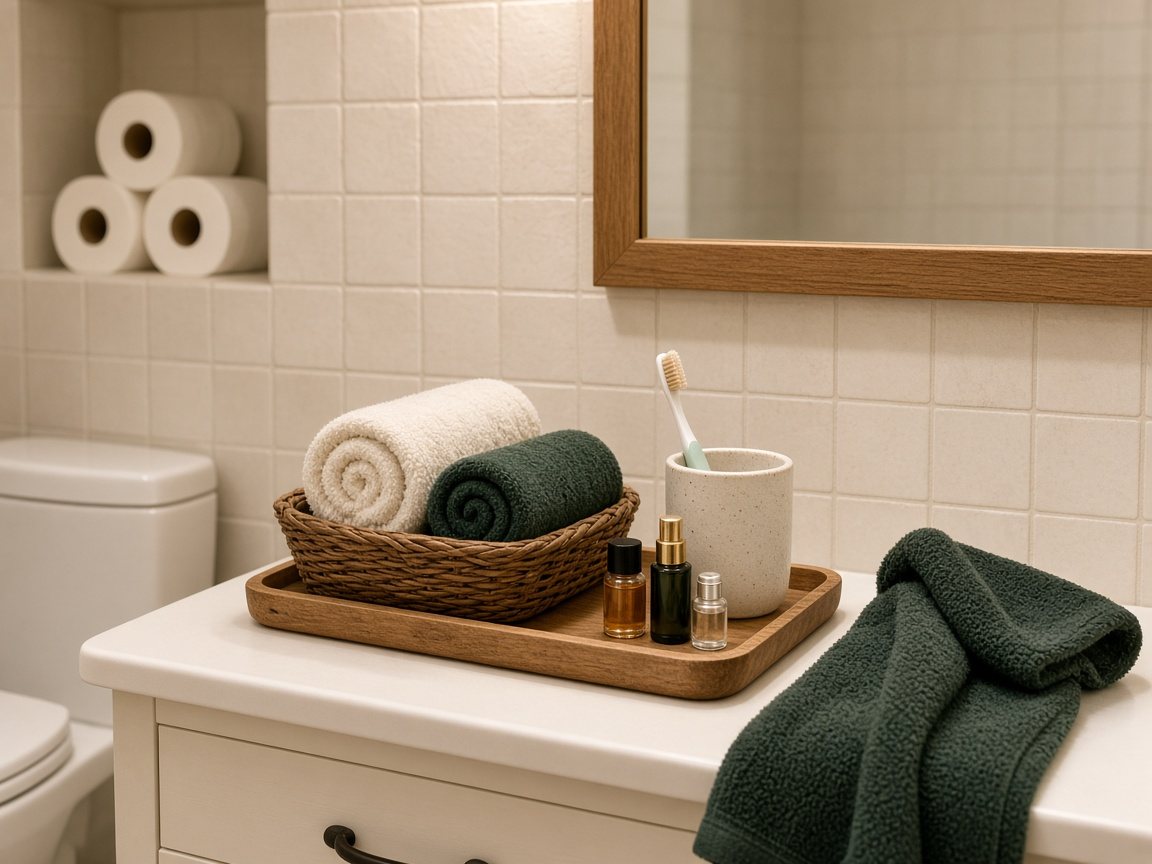
Guest bathroom checklist
If guests share your bathroom, this is still the list. You’re just clearing a corner of it for them.
Clean and clear
- Counter cleared of your daily clutter (a basket under the sink holds it for the week)
- Sink, toilet, mirror, and tub or shower cleaned
- Trash emptied, with a spare liner underneath
Castile spray and baking soda handle the sink, tub, and toilet, and a half vinegar, half water spray does the mirror. Exact amounts (plus the never-mix list) are in my natural cleaning recipes.
Restock
- Toilet paper: what’s on the roll plus several where they can see them
- Hand soap, full
- A plunger by the toilet (saves everyone an awkward moment)
- Towels and a clear hook or bar for them
- A small basket of basics: toothpaste, a spare toothbrush, period products, a few bandages
Safety
- A non-slip mat or strips in the tub or shower. NIA suggests nonskid mats or strips on any surface that may get wet and a light left on or an automatic night light for nighttime trips. (NIA)
- Medicines moved out of the cabinet if young kids are visiting
That last one matters. The Up and Away medicine safety campaign says about 35,000 young children are brought to the emergency room each year after getting into medicines left within reach, and it tells hosts to remind guests to keep purses, bags, and coats with medicines in them up and away and out of sight. (Up and Away) A high shelf in your own closet works. If you need a cleanup anyway, the medicine cabinet clean-out takes about 20 minutes.
On the low-waste side: skip the travel-size minis. A full pump of hand soap and a full bottle of shampoo in the shower serve every guest, and nothing ends up half-used in a drawer.
Entryway and coat spot
Five people arrive at once with coats, boots, bags, and a pie. Without a plan, that all lands on a chair.
- Three empty hooks (or a cleared coat closet section with empty hangers)
- A shoe spot: a tray, a mat, or a boot rack so wet boots don’t walk the house
- A basket for hats, gloves, and scarves
- A high spot for bags if little kids live in or are visiting the house (see the medicine note above)
- The porch light working and the walkway clear for evening arrivals
Clear your own extra coats out of the closet for the week. Toss them on your bed. You’ll survive.
The five-minute safety walk
Do this one week out. It’s the least fun part and the most important.
- Press the test button on every smoke alarm. The U.S. Fire Administration says to put smoke alarms inside and outside each bedroom and sleeping area and on every level, and to test them monthly. (USFA: Smoke Alarms) NFPA says the same about testing at least once a month, and notes that a single chirp every 30 or 60 seconds means a low battery. (NFPA: Smoke Alarm Information)
- Test the carbon monoxide alarms too. CPSC says CO alarms belong on every level of the home and outside sleeping areas, tested monthly, with batteries replaced each year. (CPSC: CO Alarms) It also says to make sure an alarm can’t be covered up by furniture or drapes, so check that the air mattress or pushed-back couch isn’t blocking one. (CPSC: CO Questions and Answers)
- Check the space heater plan. If a cold guest room means a space heater, USFA says to keep anything that can burn at least 3 feet from heat sources and to turn space heaters off when leaving the room or going to bed. (USFA: Heating Fire Safety) An extra blanket is the easier answer for overnight.
- Clear the path. Cords along the wall, shoes off the stairs, and throw rugs either secured or rolled up for the week.
- Walk the route with the lights off. From the guest bed to the bathroom. If you have to feel for the wall, add a night light.
A tiny kitchen handoff
You’re not giving guests the whole kitchen tour. Just the part they’ll need at 6 a.m. while you’re still asleep:
- Mugs, coffee or tea, and the kettle or coffee maker in one visible spot
- Glasses next to the sink, or a water pitcher in the fridge
- A labeled “help yourself” shelf in the fridge for breakfast basics. The 15-minute fridge reset makes room for it, and a quick freezer inventory tells you what’s already in there before you shop.
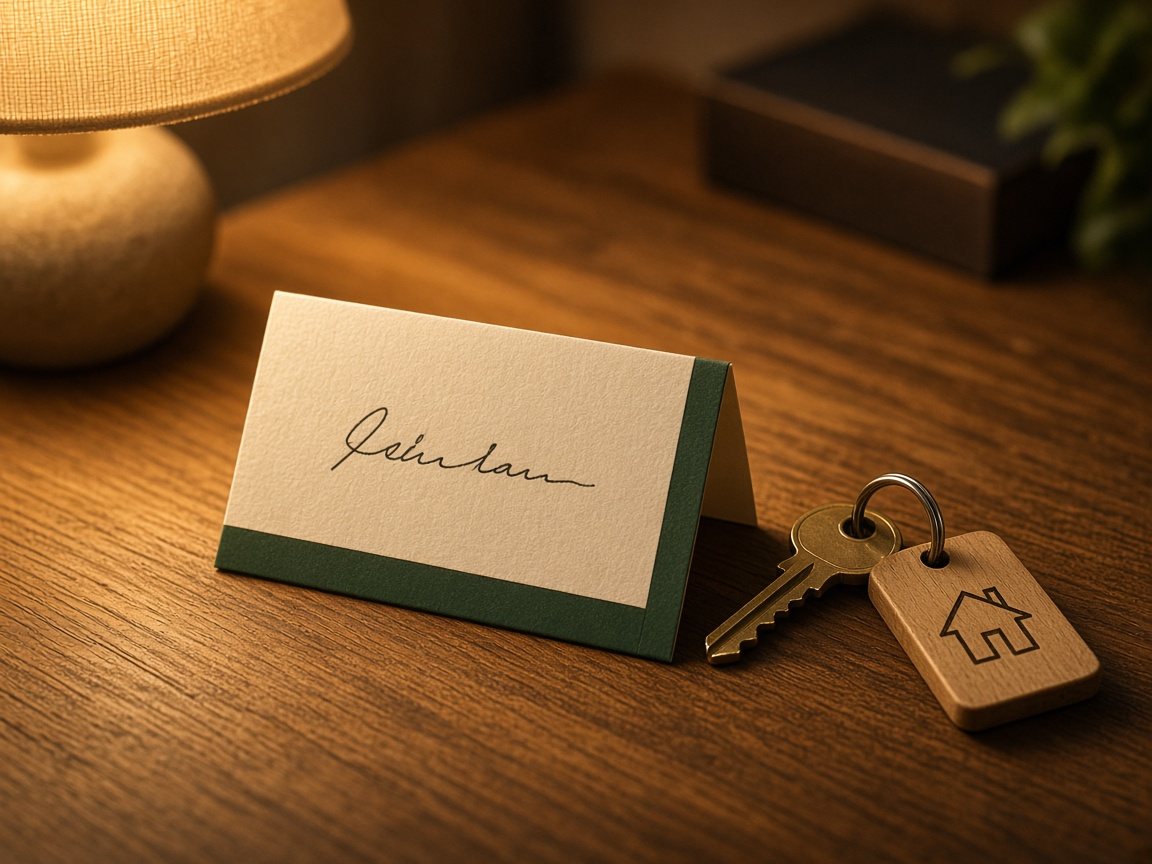
Write a guest card
The printable has a cut-out card for this. Fill it in by hand and leave it on the nightstand:
- Wi-Fi name and password
- Where the extra blankets and towels are
- Coffee, tea, and “help yourself” shelf location
- Which light switch is which, and any door that sticks
- Your quiet hours and when the house usually wakes up
Paper beats answering the Wi-Fi question six times. If you’re planning an offline evening while everyone’s together, a stack of games and a deck of cards on the coffee table does more than a TV remote. A few ideas are in screen-free winter evenings.
What not to bother with
Hosting advice online can make you think you need a boutique hotel. You don’t. Skip these:
- Deep cleaning rooms guests won’t use. Close the door. Nobody’s checking the baseboards in your craft room.
- Buying new matching bedding. Clean, dry, and not scratchy is the whole standard.
- Welcome baskets with fifteen mini toiletries. One basket of basics in the bathroom covers it. It’s less waste, too.
- Scented candles and plug-ins everywhere. Noses differ, and a guest with allergies will be the one who notices.
- Reorganizing the whole closet. Clear one section and a few hangers.
- Decorating the guest room for the season. A clean room with a lamp and a blanket feels welcoming without a single garland.
- Host gifts nobody needs. If you want to leave something on the pillow, keep it small and useful. The low-waste holiday gift list has ideas, and zero-waste gift wrapping covers the wrap.
After they leave
The day guests leave, strip the beds and start the wash. Put the clean sheets and towels back into the guest basket once they’re dry, so the next visit starts with step one already done. Then fold the house back into your normal weekly home reset. Undo the coat closet. Bring your counter basket out from under the sink.
FAQ
How far ahead should I prepare for house guests? About two weeks for a holiday visit. That gives you time to test and replace a bed, wash linens without a marathon laundry day, and spread the work into short sessions. For a weekend guest outside the holidays, three or four days is plenty.
What do guests actually need in a guest room? A comfortable bed with clean sheets, an extra blanket, a reachable light, a night light to the bathroom, one surface, one drawer or a few hangers, a spot for the suitcase, and a way to charge a phone. The rest is nice, not needed.
How many towels per guest? Plan on one bath towel and one hand towel per guest, plus a washcloth. For stays longer than about four nights, plan one towel wash mid-visit instead of buying more.
What if I don’t have a guest room? Make a sleeping spot: a couch or air mattress, a basket with their bedding, a little privacy, a night light, and a working smoke alarm nearby since that room is now a sleeping area.
Related guides
- Holiday Kitchen Prep: Fridge, Freezer, and Pantry Reset Before Thanksgiving – the kitchen half of the same countdown
- The 15-Minute Fridge Reset – room for a guest breakfast shelf
- Laundry Reset: Get the Hamper to Zero Once a Week – fit the guest linen loads into your normal week
- Medicine Cabinet Clean-Out – before little guests arrive
- The Weekly Home Reset Routine – getting back to normal after the visit
- Low-Waste Holiday Gifting and Zero-Waste Gift Wrapping – if host gifts are on your list
- Screen-Free Winter Evenings – offline ideas for a full house
- Free checklists on the free printable page
Sources
- U.S. Fire Administration. Smoke Alarms (page last reviewed October 13, 2026). Placement inside and outside each bedroom and sleeping area and on every level; test monthly; replace alarms 10 years from manufacture.
- National Fire Protection Association. Smoke Alarm Information. Test at least once a month; a chirp every 30 or 60 seconds means a low battery.
- U.S. Consumer Product Safety Commission. CO Alarms and Carbon Monoxide Questions and Answers. CO alarms on each level and outside sleeping areas; test monthly and replace batteries annually; don’t let furniture or drapes cover an alarm.
- U.S. Fire Administration. Heating Fire Safety. Keep anything that can burn at least 3 feet from heat sources; turn space heaters off when leaving the room or going to bed.
- National Institute on Aging. Preventing Falls at Home: Room by Room (content reviewed September 12, 2022). Night lights and switches near the bed, a flashlight by the bed, nonskid mats on wet surfaces, a bathroom light or automatic night light at night.
- Up and Away. Put your medicines up and away and out of sight. About 35,000 young children brought to the ER each year after getting into medicines within reach; remind guests to keep bags and coats with medicines out of reach and sight.
Save this for later
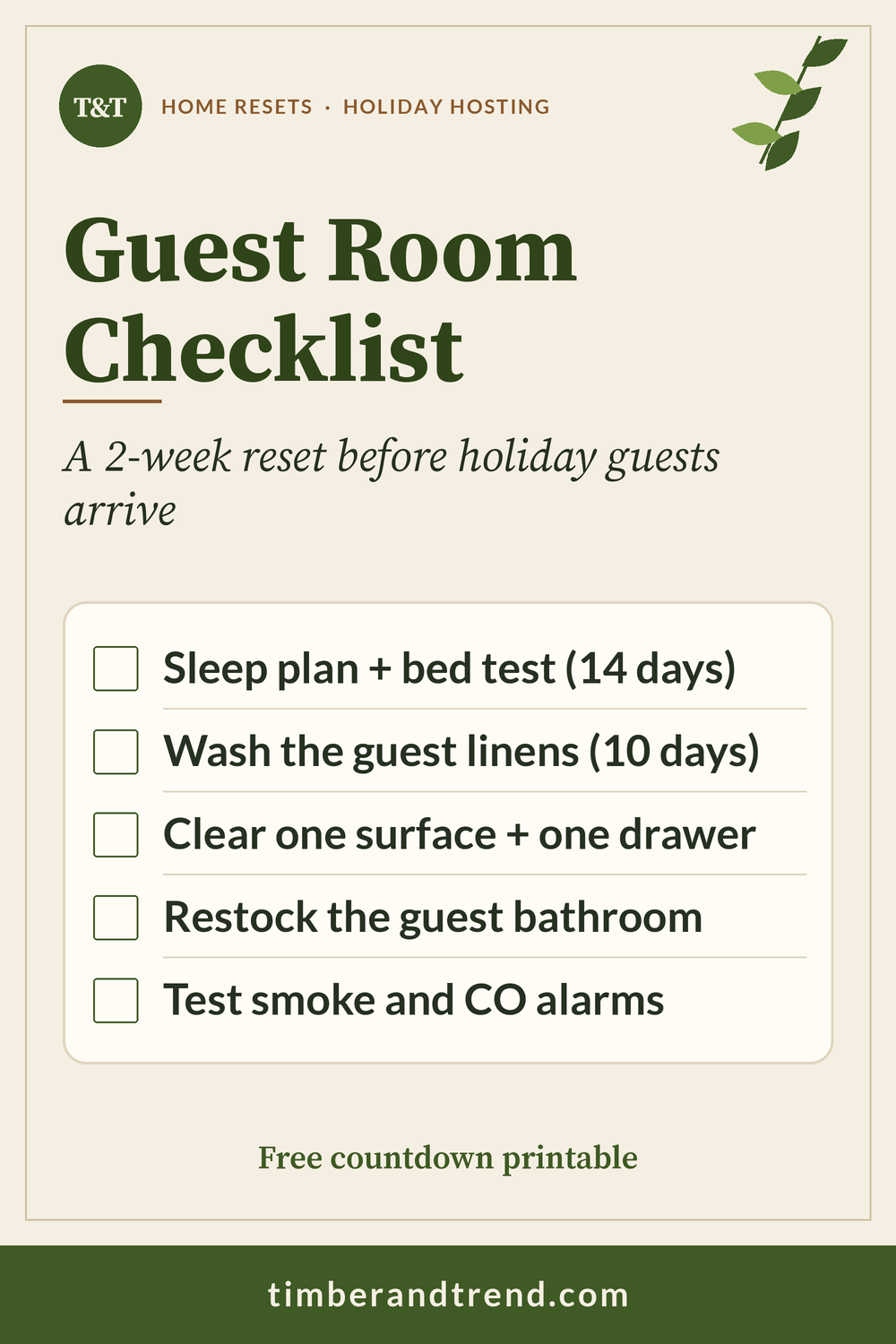
Pin it to your Holiday board so the countdown is there when the guest list firms up.
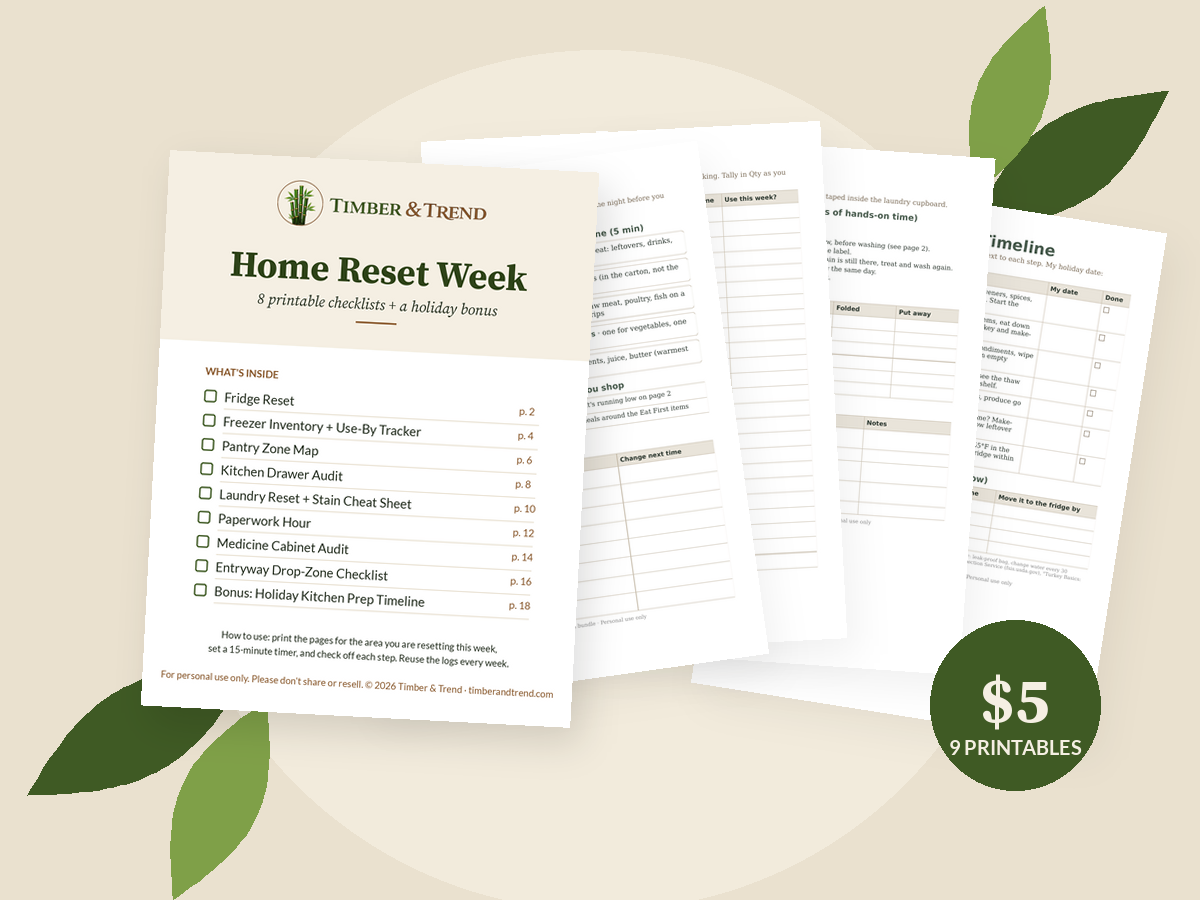
Printable bundle · $5 launch price
Get every checklist in one place
The Home Reset Week bundle has 8 printable resets (fridge, freezer, pantry, drawers, laundry, paperwork, medicine cabinet, entryway) plus a holiday kitchen prep timeline.