

If you’re bringing home a real tree Thanksgiving weekend, it has about four weeks to go before Christmas, and a little longer if you keep it up through New Year’s. That sounds like a lot to ask of a cut tree, but it’s very doable. University of Illinois Extension says many fresh-cut trees last at least five weeks when they’re cared for properly.
And “cared for properly” mostly comes down to one thing. Penn State Extension puts it plainly: keeping the tree full of water is the single most important factor in keeping it fresh and holding on to its needles. Everything below is about making that easy, plus how to pick a fresh one, where to put it, and what to do with it in January.
Free printable · 2 pages · no email needed
Tree Care Log
Page one has the bring-home checklist, a stand-size check, placement and lights boxes, and a 42-day watering log with a weekly needle check. Page two is the take-down and recycling checklist, with space for your local pickup dates and an ornament-box reset.
The short version
- Pick a fresh tree. Needles should bend, not snap, and stay put when you run your hand along a branch.
- Give it a fresh cut if it was cut more than 12 hours ago. Straight across, not angled.
- Use a stand that holds enough water: about 1 quart per inch of trunk diameter, and at least 1 gallon for most trees.
- Check the water every day, especially the first week. Plain water is all it needs.
- Keep it at least 3 feet from heat and out of the way of doors.
- Take it down when it’s dry, and recycle it through your local pickup or drop-off.
Pick a fresh one
A tree that’s already drying out on the lot won’t bounce back at home, so a minute of checking pays off.
- Run your hand along a branch. Penn State Extension’s advice is to gently run your hand along a branch and see whether the needles stay attached. A few brown needles falling from the inside is normal. Lots of green needles coming off means it’s drying out.
- Bend a needle. The Consumer Product Safety Commission says fresh needles don’t break when you bend them between your fingers, and the cut end of a fresh trunk is sticky with resin.
- Bounce it. CPSC also suggests bouncing the trunk on the ground. A shower of falling needles means the tree is too dry.
If you cut your own at a farm, you already know it’s fresh, and you can skip the recut below if it goes into water the same day.

If it’s not going up right away
Maybe you buy it Saturday and decorate next weekend. That’s fine. Penn State says to keep the trunk in water and store the tree somewhere cool, shaded and protected, like an unheated garage. Illinois Extension adds to keep it out of the wind and out of freezing temperatures, and to stand it in a bucket of water after a fresh cut.
Give it a fresh cut
When a tree sits out of water, the cut end seals over with resin and it can’t drink. Penn State says a tree cut within the past 12 hours doesn’t need a recut. Anything longer than that, cut off a fresh piece before it goes in the stand.
How much to cut depends on who you ask. Penn State says a disk about 1/4 inch thick is all you need. The NFPA tip sheet and CPSC say about 2 inches. Either works. What matters more:
- Cut straight across. Penn State says not to cut at an angle or into a V, which makes the tree harder to hold in the stand and gives it less water to drink.
- Don’t shave the sides of the trunk to make it fit the stand. The outer layers of wood are the best at taking up water.
- Get it into water soon. If the lot offers to make a fresh cut, ask for it right before you leave, and get the tree into the stand when you get home.
Use a stand that holds enough water
This is the step most people skip, and it’s the one that matters most. Penn State’s rule is a stand that holds about 1 quart of water for every inch of trunk diameter, and at least 1 gallon for most Christmas trees. Measure across the cut end of the trunk with a tape measure before you buy or dig out a stand.
| Trunk diameter | Water the stand should hold |
|---|---|
| 3 inches | at least 1 gallon |
| 4 inches | 4 quarts (1 gallon) |
| 5 inches | 5 quarts |
| 6 inches | 6 quarts (1 1/2 gallons) |
The stand also has to fit the trunk. If the ring at the top is too small, get a bigger stand instead of whittling the trunk down.

Water it every day
A fresh tree drinks a surprising amount, especially in the first week, so Penn State says to top it off daily. A few things that sound like they’d help but don’t:
- Additives. Sugar, aspirin, bleach, soda, floral preservative and commercial tree food are all unnecessary. Penn State and Illinois Extension both say plain water is all a tree needs.
- Warm water. Water temperature doesn’t change how much the tree takes up.
- Drilling holes in the trunk. Penn State says it doesn’t improve water uptake.
- Spray-on coatings and gels. Anti-transpirant sprays have little effect on a cut tree indoors, and water-holding gels in the stand can actually leave less water for the tree.
Look at the trunk, not just the stand. Penn State points out that some stands still have water in them even after the level drops below the base of the trunk. If the bottom of the trunk is out of water, the tree stops drinking. Illinois Extension says that’s when resin forms over the cut and the tree dries out quickly.
A trick for watering under the tree skirt: Illinois Extension suggests a funnel with a 3 to 4 foot piece of vinyl tubing on the end. Tie the funnel somewhere out of sight but easy to reach, run the tube down the trunk into the stand, and water through the funnel without moving a single present.
The watering log on page one of the printable is just a row of boxes to check each day. It’s the easiest way to notice you skipped a day before the tree does.
Where to put it
- At least 3 feet from heat. NFPA says to keep the tree at least three feet from fireplaces, radiators, candles, heat vents and lights. Penn State adds direct sunlight to the list of things that dry a tree out faster.
- Not blocking a door. NFPA’s tip sheet says to make sure the tree isn’t blocking an exit.
- A cooler room helps. Penn State says lowering the room temperature slows drying, so the tree uses less water each day.
Lights and safety
Home Christmas tree fires aren’t common, but they can be serious. From 2020 to 2024, U.S. fire departments responded to an average of 143 home fires a year that started with Christmas trees, and electrical distribution or lighting equipment was involved in two in five of them, according to NFPA. A well-watered tree is the first defense. Penn State notes that proper watering does more to reduce fire risk than spraying a tree with flame retardant, and some retardants can even dry the needles out faster.
A few habits from NFPA’s tip sheet:
- Use lights listed by a qualified testing laboratory, and check whether they’re rated for indoor or outdoor use.
- Replace any light string with worn or broken cords or loose bulb connections.
- Follow the package for how many strings you can connect.
- Never use lit candles on the tree.
- Turn the tree lights off before you leave the house or go to bed.
Illinois Extension also points out that miniature lights give off less heat, which means less drying.
Check it once a week
Once a week, run your fingers across the needles. Penn State says if they break easily or fall off in your hand, the tree is dry and it’s time to take it down, even if Christmas hasn’t come yet. There’s a box for this weekly check on the log, too.
Taking it down (and where it goes)
It’s tempting to leave the tree up through the first week of January. NFPA found that 35 percent of home Christmas tree fires happen in January, because the longer a tree is up, the drier and more flammable it gets. NFPA’s tip sheet also says a dried-out tree shouldn’t be left in the home or garage, or propped outside against the house.
Most cities and towns collect real trees and chip them into mulch or compost. The rules are pretty consistent from place to place. Alexandria, Virginia, New York City, Austin and Los Angeles all ask for the same things:
- Strip it bare. Remove every ornament, light, hook, strand of tinsel and the stand.
- No bags. Alexandria, New York City and Austin all say not to bag the tree. If you use a tree bag to carry it out, the Morton Arboretum says to take it off outside.
- Skip the flocking. Austin and Los Angeles don’t accept flocked (fake snow) trees for recycling.
- Wreaths and garlands come off their wire frames first, if your program takes them.
- Check your dates. Collection windows are usually a few weeks in late December and January, and some cities add park drop-off days.
Don’t burn it in the fireplace. Iowa State University Extension says dry evergreen branches can explode when burned and could start a house fire, and burning the tree can add to creosote buildup in the chimney.
No city pickup? Illinois Extension suggests putting the tree in your backyard and tucking bread and suet into the branches for the birds. The Morton Arboretum suggests laying cut branches over garden beds to insulate the soil through winter warm spells, or leaving the whole tree in the yard as winter shelter for wildlife and cutting it up in spring.
Write your pickup date on page two of the printable as soon as your city posts it. That way the tree is out the door before it’s a fire risk, and you’re not dragging it out in a rush.
Make take-down day a reset
Taking the tree down is a natural moment for a small reset instead of a rushed shove-it-all-in-the-closet job:
- Sort the ornaments as they come off. Keep, fix, or pass along. Broken hooks and dead light strings go now, not next December.
- Label the boxes by what’s inside and where it goes, so next year’s setup is quick.
- Vacuum the needles before they get tracked through the house, and wipe up any water rings under the stand.
- Write down what you’d change. Stand too small? Lights that didn’t work? Put it on your list now. The handwritten list system has a Someday list that’s perfect for this.
If January is when you like to clear out more than the decorations, the New Year declutter checklist picks up right where take-down day leaves off, and the weekly home reset routine keeps things from drifting back.
Lower-waste tree season
A real tree that gets watered, enjoyed and then chipped into mulch is a pretty low-waste way to do the season. A few more ways to keep it that way:
- Reuse what you already have. Ornaments you’ve kept for years count, and neutral dried stems from your fall decor can often stay out through December.
- Wrap in fabric or kraft paper. The zero-waste gift wrapping guide shows the furoshiki folds, and the low-waste holiday gift ideas list is full of things that won’t end up in a drawer.
- Make an evening of decorating. Music on, phones away. It’s one of the better screen-free winter evenings of the year.
Free printable: Tree Care Log
Two pages, no email needed:
- Setup and watering log with the freshness checks, a stand-size check (measure the trunk, write down how much water you need), a placement and lights checklist, and 42 numbered days to check off each time you top up the water, plus a weekly needle check
- Take-down and recycling checklist with signs it’s time, spaces for your local pickup or drop-off dates, the strip-it-bare list, and a take-down reset for the ornament boxes
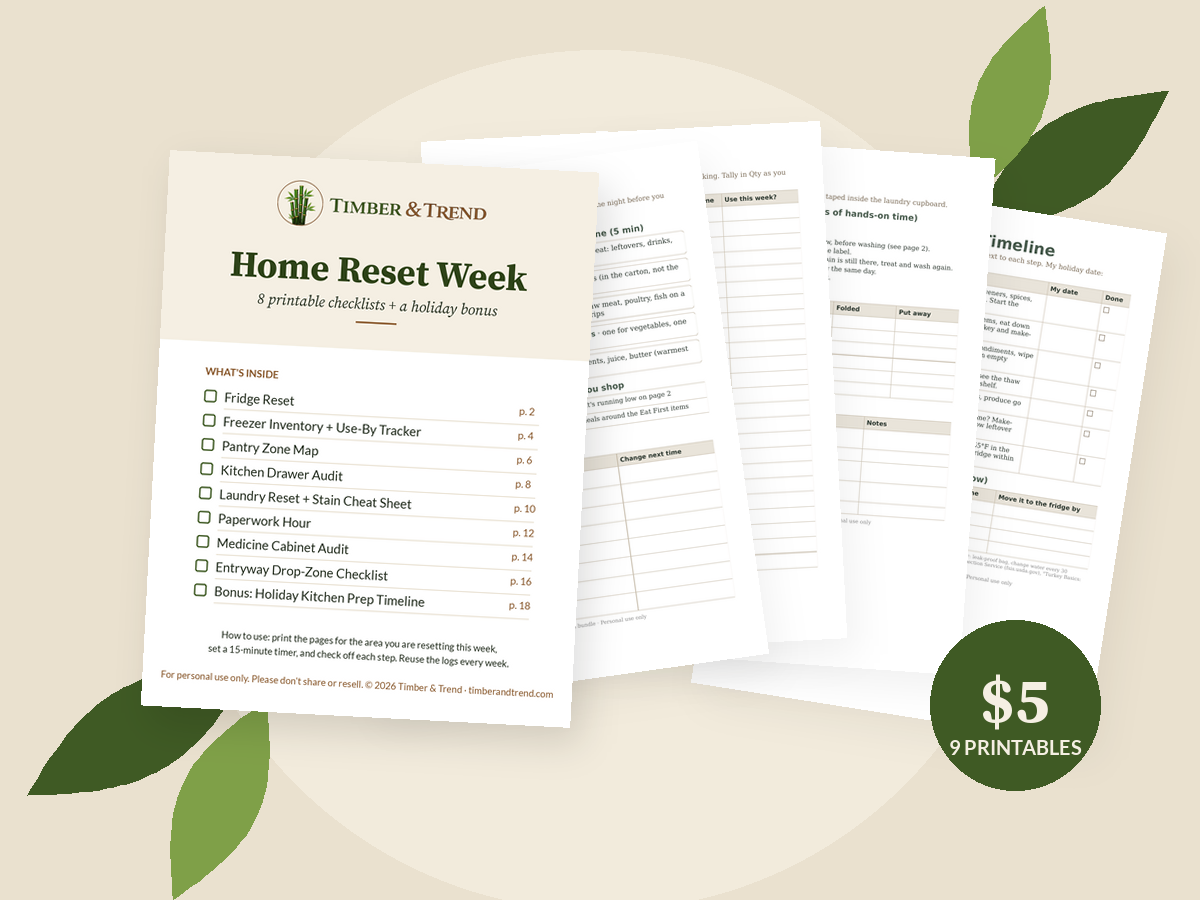
Hosting over the holidays too? The guest room checklist and the Christmas card guide cover the rest of December, and the $5 Home Reset Week bundle has the room-by-room resets for after.
FAQ
How often should you water a real Christmas tree?
Check it every day and top it off. Penn State Extension says a cut tree takes up a surprising amount of water, especially in the first week. Keep the water above the bottom of the trunk at all times.
How much water does a Christmas tree need?
Use a stand that holds about 1 quart of water per inch of trunk diameter, and at least 1 gallon for most trees, per Penn State Extension. A tree with a 5-inch trunk needs a stand that holds about 5 quarts.
Should you put sugar or aspirin in Christmas tree water?
No. Penn State and Illinois Extension both say plain water is all a tree needs. Additives like sugar, aspirin, bleach and tree preservatives aren’t necessary.
How long does a real Christmas tree last?
Illinois Extension says many fresh-cut trees last at least five weeks with proper care. Run your fingers across the needles each week. If they break easily or fall off in your hand, the tree is dry and should come down.
Can I burn my Christmas tree in the fireplace?
No. Iowa State University Extension says dry evergreen branches can explode when burned and could start a house fire, and they can add to creosote buildup in the chimney. Recycle it through your local program instead.
Related guides
- Activity advent calendar: 24 low-waste December ideas
- Zero-waste gift wrapping
- Low-waste holiday gift ideas
- How to write Christmas cards without the stress
- Screen-free winter evenings
- The guest room checklist
- Fall decor that lasts
- The New Year declutter checklist
- The handwritten list system
- More in Home Resets, Sustainable Living, Analog Life and Curated Essentials
Sources
- Penn State Extension: Caring for Your Cut Christmas Tree
- Penn State News: Choosing a real Christmas tree? Extension expert gives tips for selection, care
- University of Illinois Extension: Caring for Live Christmas Trees
- NFPA: Winter holidays fire facts
- NFPA: More than one-third of Christmas tree home fires occur in January (Jan. 5, 2026)
- NFPA: Christmas Tree Safety tip sheet (PDF)
- U.S. Consumer Product Safety Commission: Holiday Decoration Safety Tips (PDF)
- Iowa State University Extension: Can I burn my Christmas tree in the fireplace?
- The Morton Arboretum: How to Dispose of Your Live Christmas Tree
- City of Alexandria: Reduce Holiday Waste
- NYC311: Christmas Tree Disposal
- City of Austin: Holiday Tree Recycling
- LA Sanitation and Environment: Christmas Tree Recycling
Save this for later
Pin it to your Holiday board so the card list, message starters and mail-by dates are there when you sit down to write.

Printable bundle · $5 launch price
Get every checklist in one place
The Home Reset Week bundle has 8 printable resets (fridge, freezer, pantry, drawers, laundry, paperwork, medicine cabinet, entryway) plus a holiday kitchen prep timeline.