
January is when a lot of us look around the house and decide it’s time. The trouble is that “declutter the house” isn’t a task. It’s a hundred tasks wearing a trench coat, and trying to do it all in one weekend usually ends with every closet emptied onto the bed and nothing actually leaving.
This checklist breaks it down the other way: one small zone a day, about fifteen to twenty minutes, for a month. A drawer, not a kitchen. One shelf, not the whole closet. By the end of the month you’ve touched every room, and the things you’ve decided to let go have actually left the house, which is the part most declutter plans skip.
Free printable · 3 pages · no email needed
New Year Declutter Kit
Page one is a 31-day declutter calendar with one small zone a day and a tally for what left the house. Page two is a room-by-room declutter checklist. Page three is an out-the-door log for donations, special drop-offs and returns, with a spot for the maybe box date.
Affiliate disclosure: This post contains affiliate links. As an Amazon Associate, I earn from qualifying purchases, so if you buy through one of these links I may earn a commission at no extra cost to you. The scene and stock images in this post are for display and inspiration only and may not show the exact items linked.
The short version
- One zone a day. Small enough to finish in fifteen to twenty minutes, with a timer.
- Sort into five spots: keep, elsewhere, out the door, special drop-off and trash.
- Ask four quick questions about anything you hesitate on.
- Follow the 31-day plan: kitchen first, then bathrooms and bedrooms, living spaces, paper and storage.
- Get it out of the house the same week, and write each drop-off in your planner.
- Keep it from coming back with a one-in, one-out habit and your weekly reset.
Before you start: five spots and a timer
Set up your sorting spots before you open the first drawer. A laundry basket, a couple of boxes and a trash bag are plenty.
- Keep. It’s used, it’s wanted, and it goes back in its home.
- Elsewhere. It’s a keeper, but it lives in another room. Use one basket, and put everything in it away when the timer goes off, not as you find it. Walking each item to its room is how fifteen minutes turns into an afternoon.
- Out the door. Donate, sell, give to a friend or return to whoever lent it.
- Special drop-off. Batteries, old electronics, leftover medicines, paint and cleaners. These don’t go in the trash or the donation bag, and they get their own section below.
- Trash and recycling. Broken, stained, expired or missing parts.
Then set a timer for fifteen or twenty minutes and stop when it rings. Finishing small is what makes you come back tomorrow.

The maybe box
If you’re truly stuck on something, put it in one box, tape it shut and write today’s date and a date three months out on the side. If you haven’t opened the box by then, it goes out the door unopened. Keep only one maybe box, so it can’t turn into a second storage room.
Four questions for the things you hesitate on
Most of a drawer is easy. It’s the last few things that take the time. When you pick something up and pause, ask:
- Have I used it in the last year? Seasonal things get a full year. Everything else, be honest.
- If it broke tomorrow, would I buy it again? If not, you’ve already decided.
- Do I have another one that does the same job? Keep the better one.
- Can I name its home? If it doesn’t have a spot, it’ll be clutter again next month, so either give it a spot or let it go.
There are no wrong answers here. You’re not aiming for an empty house. You’re aiming for a house where everything has a place and gets used.
The 31-day declutter plan
Here’s the full month, one zone a day. Weekdays are small zones and a few weekend days are a little bigger. It’s not dated, so start on January 1 or the first of any month, and if you miss a day, just pick up where you left off. The printable has the same plan as a calendar you can check off.
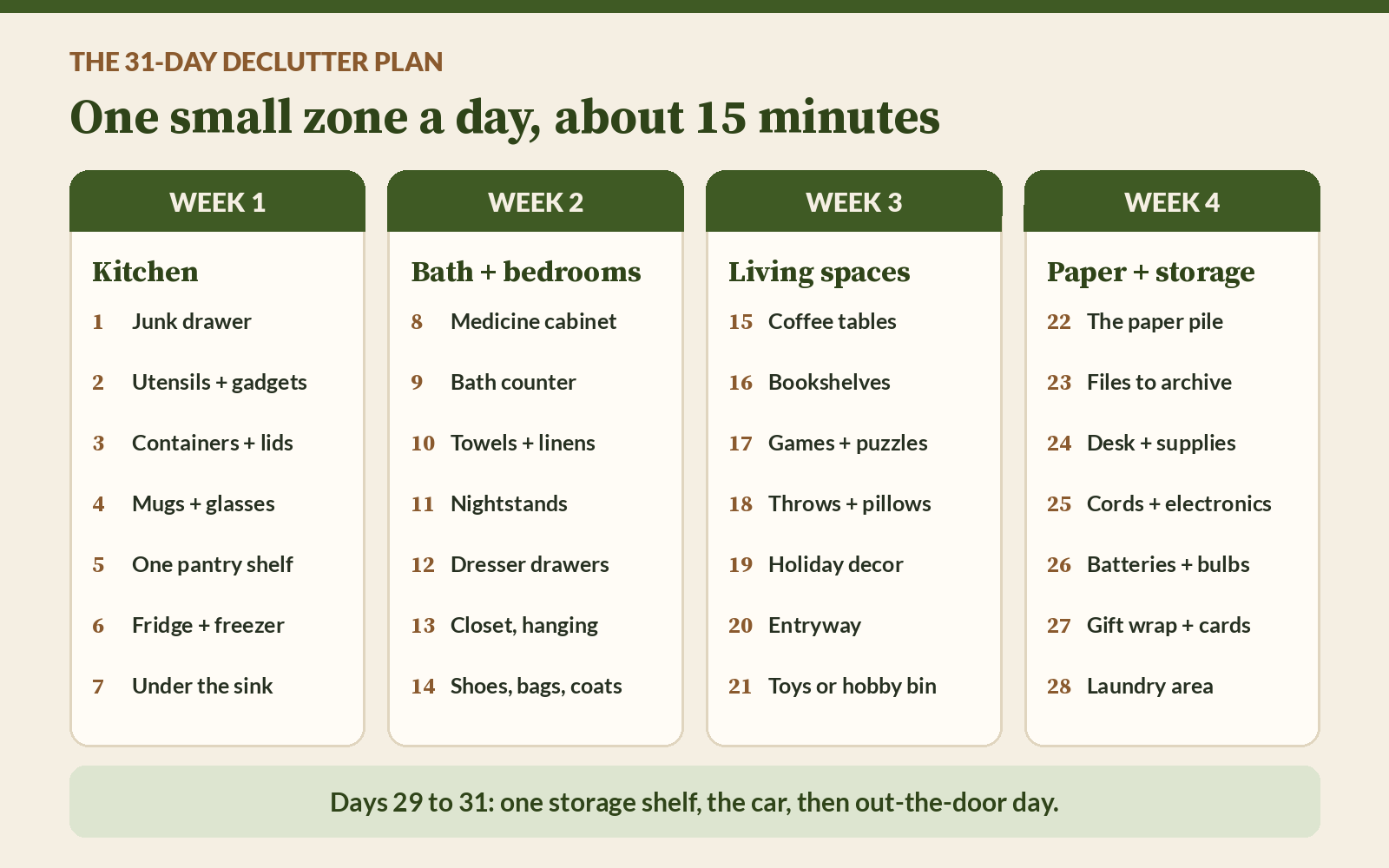
Week 1: the kitchen (days 1 to 7)
The kitchen comes first because it’s used every day, so you feel the difference right away.
- Day 1: the junk drawer. Empty it, toss dead pens and mystery keys, and give what’s left a small tray or box.
- Day 2: utensils and gadgets. Keep the ones you reach for. Duplicates and single-use gadgets go in the out-the-door box.
- Day 3: food storage containers. Match every container to a lid. Anything without a partner goes.
- Day 4: mugs, glasses and water bottles. Keep what fits on the shelf with a little room to spare.
- Day 5: one pantry shelf. Check dates and group like with like. The pantry reset does this without buying a single container.
- Day 6: fridge and freezer. Run the 15-minute fridge reset and update your freezer inventory so the things in there get eaten.
- Day 7: under the sink. Keep the cleaners you actually use, never pour different products together, and set aside anything you won’t use for the special drop-off. If you’d like to simplify what lives here, these natural cleaning recipes cover most jobs with a few basics.
As things run out, the low-waste kitchen swaps guide has a “swap when it runs out” approach, so you don’t replace a drawer of plastic all at once.
Week 2: bathrooms and bedrooms (days 8 to 14)
- Day 8: the medicine cabinet. Check dates and set aside anything expired or unused for proper disposal. The medicine cabinet clean-out walks through it step by step.
- Day 9: bathroom counter and shower. Old samples, nearly empty bottles, products you tried once.
- Day 10: towels and the linen closet. Keep a set or two per person plus guest towels. Worn towels make good rags, and the guest room checklist has the linen basics if you host.
- Day 11: nightstands. Just the drawer and the top.
- Day 12: dresser drawers. One drawer at a time. Socks without partners, stretched-out basics, anything that doesn’t fit.
- Day 13: the closet, hanging clothes. Turn every hanger backward today. When you wear something, hang it back the right way. Whatever’s still backward in a few months is easy to let go.
- Day 14: shoes, bags and coats. Keep the bags you carry. If one of them is your everyday tote, pack it like an analog bag so the essentials stay put.
Clothes with a loose button or a small tear go to a mend pile, not the donation bag, if you’d actually wear them again. The mending basket makes clearing that pile a monthly twenty-minute job.

Week 3: living spaces (days 15 to 21)
- Day 15: coffee table and side tables. Clear everything off, then put back only what’s used in that room.
- Day 16: bookshelves. Keep the books you’ll read or reread. Pass the rest to a friend, a library sale or a little free library.
- Day 17: games and puzzles. Count pieces if you can. Complete sets can be donated, and the keepers are ready for screen-free winter evenings.
- Day 18: throws, pillows and blankets. Keep what you use and what fits in its basket.
- Day 19: holiday decor, as you pack it away. Only pack what you put out this year, plus anything you’re glad to see again. If you kept fall pieces simple with fall decor that lasts, this goes quickly.
- Day 20: the entryway. Hooks, the shoe pile and whatever lands on the table by the door.
- Day 21: toys or hobby supplies. Pick one bin. If you’ve got a half-started craft, decide whether it’s a someday project or a let-go. These slow hobbies list what each one actually needs to get started, which helps with deciding what to keep.
Week 4: paper and storage (days 22 to 28)
- Day 22: the paper pile. Sort the mail and papers on the counter. A monthly Paperwork Hour keeps it from coming back, and it covers what to keep and what to shred. While you are in the paper zone, the household ICE binder is a good home for the grab-and-go copies.
- Day 23: files to archive. Move last year’s files that you need to keep out of the active drawer and into a labeled box, so the drawer only holds what’s current.
If your files are already in hanging folders, a file box that takes them as they are saves you from re-sorting everything.
As an Amazon Associate, I earn from qualifying purchases.
- Day 24: desk and office supplies. Test pens, recycle old notebooks you won’t use and corral the rest.
- Day 25: cords, chargers and old electronics. Match each cord to a device you still own. The rest goes to the special drop-off (see below).
- Day 26: batteries and light bulbs. Gather the loose ones in one place. Used batteries go to the special drop-off, not the trash.
- Day 27: gift wrap, cards and ribbon. Keep what you’ll reuse. The zero-waste gift wrapping guide has ideas for the paper and bags you saved from December.
- Day 28: the laundry area. Old detergent, lost socks and the stain remover you bought twice. Then take five minutes for a laundry reset.
Days 29 to 31: the last stretch
- Day 29: one garage or storage shelf. Paint, old cleaners and garden chemicals go to household hazardous waste collection, not the trash.
- Day 30: the car. Glove box, trunk, door pockets.
- Day 31: out-the-door day. Load the car and drop everything off. Then write the maybe box’s open-by date in your planner.
Where everything goes (so it actually leaves)
The out-the-door box only works if it leaves the house. Here’s where the trickier things go.
Donations
Call or check the website of your local donation center before you load up, because what each one accepts varies. Donate things that are clean and work. If you plan to deduct donations on your taxes, the IRS says you can’t deduct clothing or household items unless they’re in good used condition or better, and the deduction is based on what similar used items actually sell for, not what you paid (IRS Publication 526). Keep a quick list of what you gave and where. The out-the-door log in the printable has columns for that.
Clothes and linens that can’t be donated
Textiles add up. EPA estimates that U.S. landfills received 11.3 million tons of textiles in 2018 (EPA). Stained or torn items can become rags, and many towns, donation centers and retailers run textile drop-offs. Earth911’s recycling search can help you find one near you.
Kids’ gear and baby items
Before you sell or donate them, check cpsc.gov/recalls. The CPSC says it’s illegal to sell a recalled product, and it’s your responsibility as the seller to check (CPSC). The same page notes that cribs made before June 28, 2011 are very likely out of line with the current federal crib standards and illegal to sell or distribute, so those shouldn’t go in the donation pile. Checking takes a couple of minutes per item.
Old phones, laptops and chargers
EPA’s checklist before you donate or recycle electronics: delete all personal information, and remove any batteries, which may need to be recycled separately. Lithium-ion batteries, and devices that contain them, should not go in household garbage or recycling bins (EPA). Call2Recycle and Earth911 both list drop-off locations.
Batteries
To prevent fires, EPA says to tape the terminals of lithium-ion batteries or put each battery in its own plastic bag, and never put them in household garbage or recycling bins (EPA). Keep a small jar for used batteries and take it in when it’s full. Call2Recycle has a drop-off locator.
Leftover medicines
FDA’s first choice is a drug take-back location, like many pharmacies, or a prepaid mail-back envelope. If neither is available, check FDA’s flush list; if the medicine isn’t on it, mix it with something unappealing like used coffee grounds or cat litter, seal it in a bag and put it in the trash, and scratch out the personal information on the label (FDA).
Paint, cleaners and chemicals
EPA counts leftover paints, cleaners, oils, batteries and pesticides as household hazardous waste. Keep them in their original containers, don’t mix them, and check with your local solid waste agency for a collection site or collection day (EPA).

Keep it from coming back
Decluttering once is the easy part. These habits keep February from looking like December.
- One in, one out. When something new comes in, something similar goes in the out-the-door box.
- Keep a donation bag in a closet. When you find something on a regular day, it goes straight in the bag.
- Fold it into your weekly reset. The weekly home reset routine already touches the kitchen, laundry and paper each week. Add one small zone a week and the house stays decluttered without another big month.
- Put “someday” ideas on paper, not in the closet. That project you’re keeping supplies for can live on a someday list instead. The handwritten list system keeps one in the back of a notebook.
- Ask for gifts that get used up. The low-waste gift ideas list works for your own wish list, too.
- Put the dates in your planner. Drop-off day, the maybe box’s open-by date and a quarterly zone check. The paper planner setup has a spot for monthly reset dates.
That’s the whole plan: five sorting spots, four questions and one small zone a day. Print the kit, put the calendar on the fridge and start with the junk drawer. For more room-by-room routines, see Home Resets. For the low-waste side of letting things go, see Sustainable Living, and for paper-first planning, see Analog Life. Our Curated Essentials page explains how we choose the tools we link.
Sources
- U.S. EPA. Textiles: Material-Specific Data. Facts and Figures about Materials, Waste and Recycling (2018 data).
- U.S. EPA. Electronics Donation and Recycling.
- U.S. EPA. Used Household Batteries.
- U.S. EPA. Household Hazardous Waste (HHW).
- U.S. FDA. Disposal of Unused Medicines: What You Should Know.
- Internal Revenue Service. Publication 526, Charitable Contributions. Clothing and household items; determining fair market value.
- U.S. Consumer Product Safety Commission. Stopping the Online Sale of Recalled Products and Recalls.
- Earth911 recycling search and Call2Recycle drop-off locator.
Related guides
- The weekly home reset routine
- Pantry reset without buying a single container
- Medicine cabinet clean-out
- Paperwork Hour
- The mending basket
- How to set up a paper planner for the new year
- Taking down and recycling a real Christmas tree
Save this for later
Pin it to your Home Resets board so the 31-day plan is ready when January 1 rolls around.
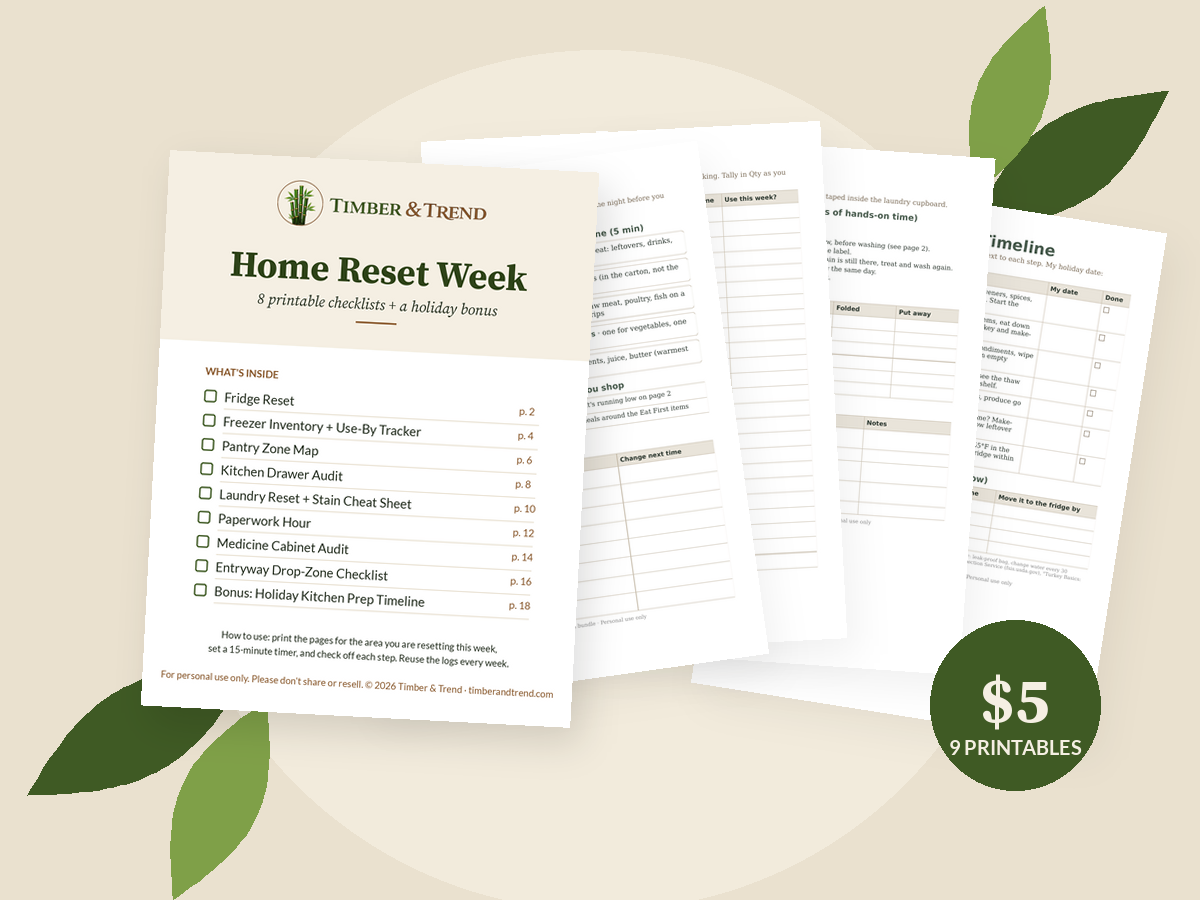
Printable bundle · $5 launch price
Get every checklist in one place
The Home Reset Week bundle has 8 printable resets (fridge, freezer, pantry, drawers, laundry, paperwork, medicine cabinet, entryway) plus a holiday kitchen prep timeline.