
Winter evenings are long, and the easy default is a screen. A slow hobby is the other option: something you do with your hands or your attention, at your own pace, that gives you a small finished thing or a better eye for the world around you.
You’re not alone in wanting one. Michaels reported in its 2026 Creativity Trend Report that searches for analog hobbies like knitting, crocheting, embroidery, journaling and painting rose 136 percent over six months (Michaels). And a 2023 study of more than 93,000 adults aged 65 and older across 16 countries found that having a hobby was linked with higher happiness and life satisfaction over time (Nature Medicine). That’s an association, not a promise, but it’s a nice nudge.
The catch is the shopping. It’s easy to buy a full kit, use it twice, and feel guilty about the bag in the closet. So this list does it the other way around: twelve hobbies, what each one really needs to start, what to borrow or reuse first, and a small first win so you know whether you like it before you spend more.
Free printable · 2 pages · no email needed
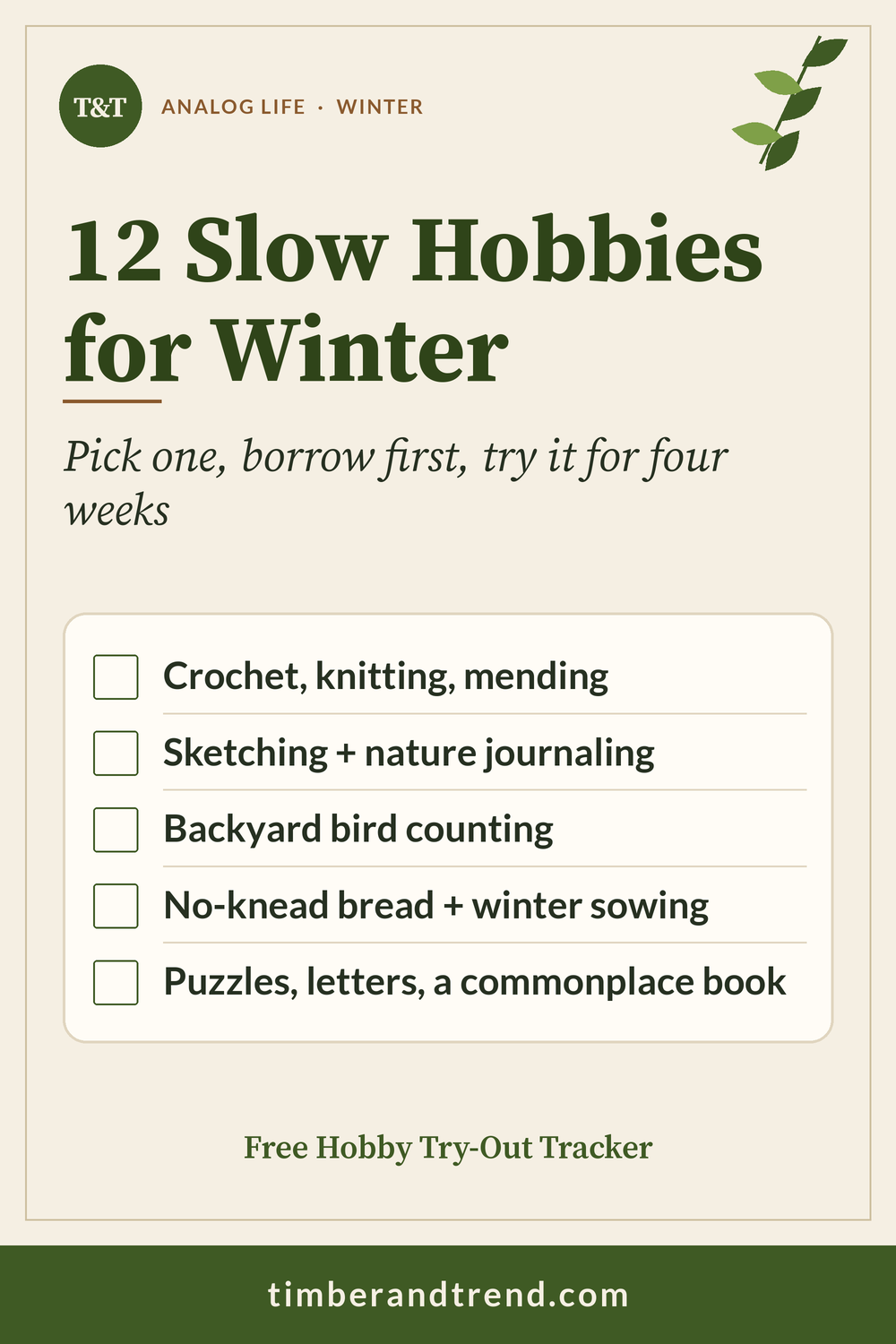
Hobby Try-Out Tracker + 12 Slow Hobbies at a Glance
Page one is a four-week try-out log for one hobby: what you already have, what to borrow, your first small win, a session log and a keep, switch or pass-it-on decision at the end. Page two lists all twelve hobbies with what to start with, what to borrow first and a first small win, plus winter dates for bird counts and winter sowing.
Affiliate disclosure: This post contains affiliate links. As an Amazon Associate, I earn from qualifying purchases, so if you buy through one of these links I may earn a commission at no extra cost to you. The scene and stock images in this post are for display and inspiration only and may not show the exact items linked.
How to pick one (and actually keep it)
- Pick one, not three. One hobby for four weeks tells you more than three hobbies for a week each.
- Borrow or reuse before you buy. Libraries, a friend’s spare hook, a thrift store yarn bin, saved jars and milk jugs. Buy the second round of supplies, not the first.
- Aim for a first small win. A practice square, one loaf, one page of sketches. Something finished in a sitting or two.
- Give it a home. One basket or one cloth bundle near where you sit in the evening. If the supplies live in a closet, the hobby does too.
- Decide at week four. Keep going, switch to a different hobby, or pass the supplies on to someone who’ll use them. All three are fine.
The printable tracker walks you through those five steps, so you don’t have to keep them in your head.
Hands busy: yarn, thread and needle
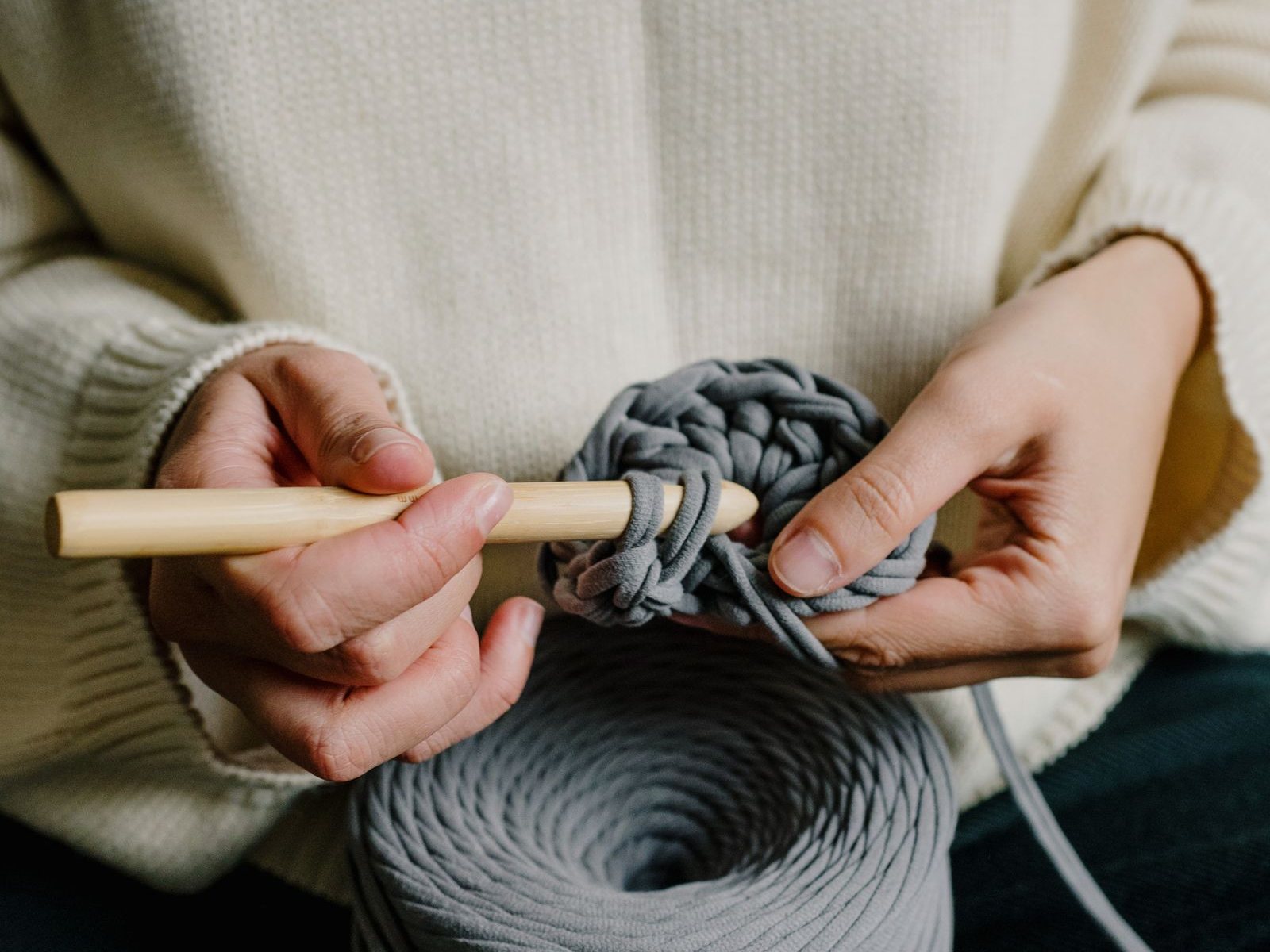
1. Crochet
What you need to start: one skein of smooth, light-colored medium (worsted) weight yarn and one crochet hook. The Craft Yarn Council’s standard yarn weight chart pairs medium weight yarn with hooks from 5.5 to 6.5 mm (Craft Yarn Council), and a light color makes your stitches easier to see.
Borrow or reuse first: a hook from a friend or a thrift store craft bin, and a learn-to-crochet book from the library.
First small win: a practice square. The Craft Yarn Council’s free single crochet lesson walks you through a 7 by 9 inch block from the very first chain (Craft Yarn Council). Crochet that one block and you’ll know whether you want a second.
2. Knitting
What you need to start: the same smooth medium weight yarn and one pair of needles. The Craft Yarn Council chart lists US sizes 7 to 9 for that weight (Craft Yarn Council).
Borrow or reuse first: needles turn up in thrift stores and in relatives’ drawers all the time. Ask before you buy.
First small win: a garter stitch dishcloth or a plain scarf. It’s all one stitch, so your hands learn the rhythm without a pattern to follow.
3. Visible mending
What you need to start: a needle, some thread or embroidery floss, a scrap of fabric and the clothes you already own that need help.
Borrow or reuse first: fabric from a shirt that’s past saving. This is the cheapest hobby on the list because the “project” is already in your closet.
First small win: one patched elbow, one darned sock heel or one replaced button. The mending basket guide has five beginner fixes and a 20-minute monthly mend session.
4. Embroidery
What you need to start: a hoop, a needle with a big eye, a few colors of floss and a piece of plain cotton.
Borrow or reuse first: an old pillowcase or tea towel makes good practice fabric.
First small win: your initials or a simple sprig of leaves on a tea towel. Backstitch alone is enough for a first piece.
Keep the project in one bundle
Yarn projects wander. A ball of yarn ends up under the couch and the hook ends up in a coat pocket. The fix is simple: keep the yarn, the tool and the pattern together, and keep them where you sit. A tote you already own works. So does a large square of cloth, tied up like a bundle, which you can untie into a lap mat when you start working.
If you’d like a dedicated cloth, a big one is the most useful size. It wraps a whole project now and works as gift wrap in December (the zero-waste gift wrapping guide has the folds).
As an Amazon Associate, I earn from qualifying purchases.
Eyes open: paper, pencil and the window
5. Sketchbook drawing
What you need to start: a pencil and something small to draw in. A pocket notebook is less intimidating than a big sketchbook, and it fits in an analog bag.
Borrow or reuse first: the back pages of an old notebook, or printer paper folded in half and stapled.
First small win: one small sketch a day for a week. The mug, the lamp, your hand. It doesn’t need to look right. It needs to exist.

6. Nature journaling
What you need to start: the same pencil and notebook, plus a window or a short walk.
How to start: naturalist John Muir Laws teaches three prompts for looking closely at anything in nature: “I notice,” “I wonder” and “it reminds me of.” He suggests saying your observations out loud, because it helps you see and remember more (John Muir Laws).
First small win: one page about one thing. A single leaf, a pinecone, the bird that keeps landing on the fence. Write what you notice, one question you have, and what it reminds you of.
As an Amazon Associate, I earn from qualifying purchases.
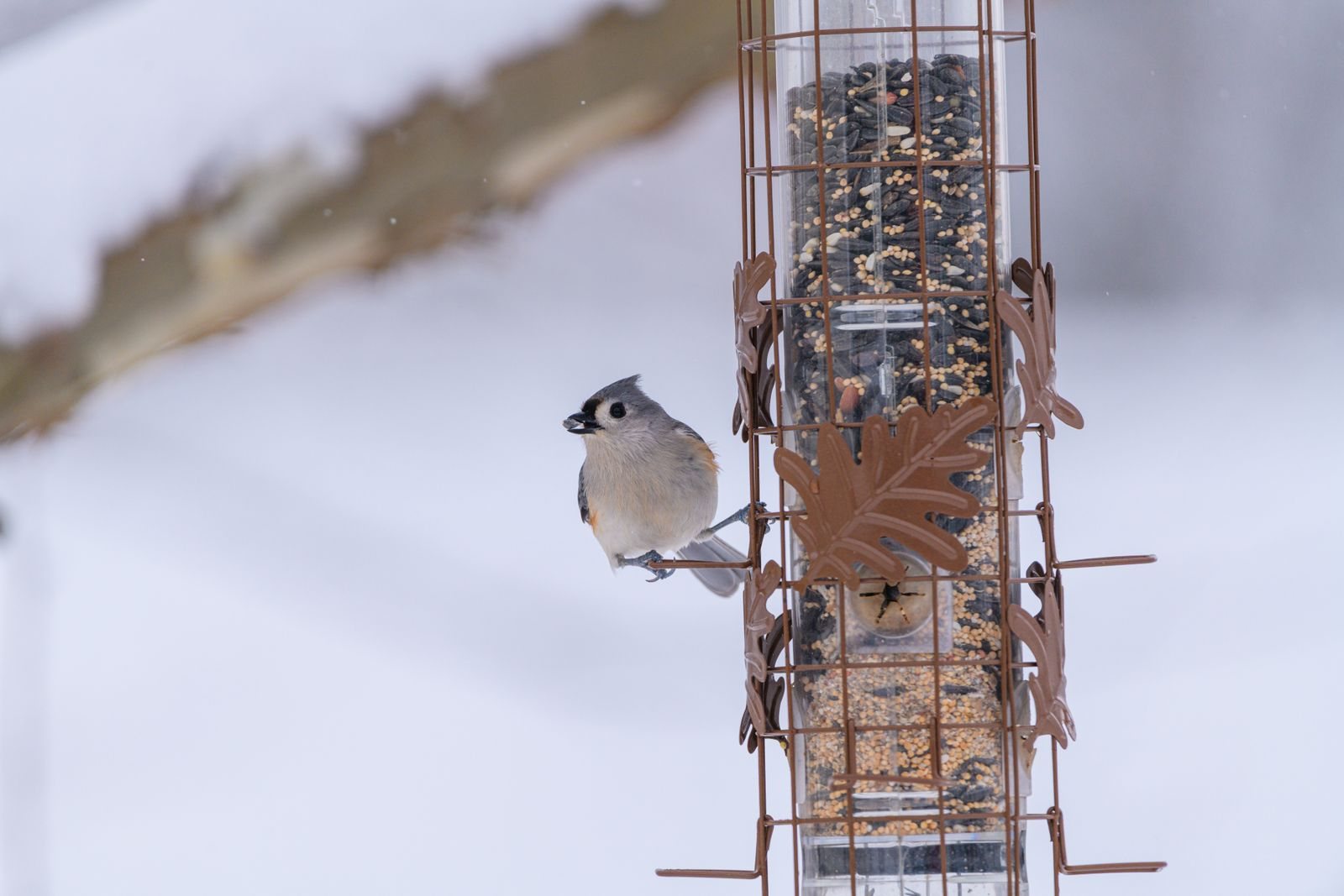
7. Backyard bird counting
What you need to start: a window with a view of a tree, a feeder or a patch of yard. Binoculars help, but they’re optional on day one.
Why winter is the season: Project FeederWatch, run by the Cornell Lab of Ornithology and Birds Canada, is a November to April survey of birds that visit backyards and community spaces. You don’t even need a feeder, and you can count every week or once all winter. U.S. participants pay an $18 annual fee that supports the project (Project FeederWatch). If you’d rather join a group, Audubon’s Christmas Bird Count runs from December 14 to January 5. It’s free and open to beginners, and some circles accept feeder counts from home (Audubon). You do need to sign up with your local circle’s compiler ahead of time (Audubon).
First small win: a 15-minute count from the same window. Write down every bird you can identify, and sketch the ones you can’t.
8. Letter writing
What you need to start: paper, envelopes and stamps. That’s it.
Borrow or reuse first: the stationery and cards that are already in a drawer somewhere. Most homes have more than they think.
First small win: one letter a week through the end of the year. Holiday cards count, and a two-line note counts too.
Kitchen and windowsill
9. Bread baking
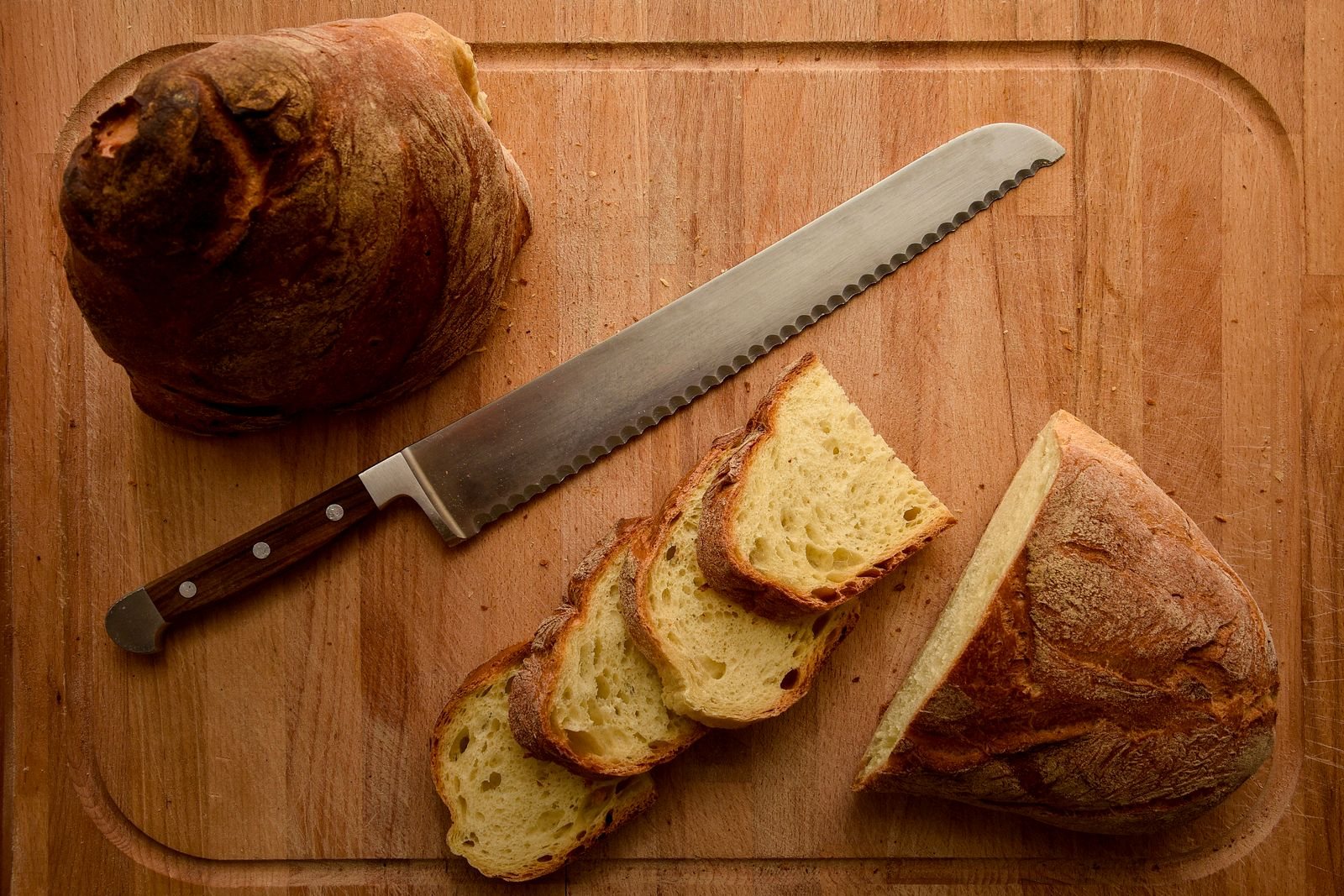
What you need to start: flour, instant yeast, salt and water, plus a bowl and a spoon. King Arthur Baking’s beginner bread roundup says its No-Knead Crusty White Bread needs only those four ingredients and about 5 minutes of hands-on time, with about 6 hours start to finish (King Arthur Baking).
Borrow or reuse first: the baking sheet and mixing bowl you already own. A loaf pan can wait until you’re sure you’ll make sandwich bread.
First small win: one loaf. Then use the ends: the leftover night guide has ideas for stale bread, and saved jars from the low-waste kitchen swaps hold flour and yeast.
10. Winter sowing
What you need to start: clear plastic jugs (washed milk jugs work), potting mix, seeds and tape. This is gardening you start in winter, outside, with no grow lights.
How it works: Penn State Extension describes winter sowing as planting seeds in containers that stay outdoors all winter until the seedlings come up in spring. The cold helps break the seeds’ dormancy (Penn State Extension). University of Missouri Extension’s one-page guide covers the steps: drainage holes, about 3 inches of moist potting mix, a label inside, and a spot that gets sun, rain and snow (MU Extension).
Borrow or reuse first: the jugs come out of your recycling bin, and some public libraries run seed libraries or seed swaps.
First small win: one labeled jug of cold-hardy seeds set outside in late winter. It’s a quiet thing to check on in February.
Quiet evenings
11. Jigsaw puzzles
What you need to start: one puzzle and a flat spot where it can stay out for a week.
Borrow or reuse first: some libraries, community centers and neighborhood groups run puzzle swaps. A puzzle you’ve finished is a great thing to pass along.
First small win: a 300 to 500 piece puzzle on a tray, so you can move it off the table at dinner. There are more cozy evening ideas in screen-free winter evenings.
12. A commonplace book
What you need to start: a notebook and whatever you’re reading.
How it works: a commonplace book is an old habit of copying lines you want to keep: a sentence from a novel, a recipe note, a quote from a letter. It’s slower than a screenshot, which is the point. Writing it out makes you choose.
First small win: one copied passage for every book you finish this winter. Keep it with your paper planner so both live in the same spot.
The four-week try-out
Here’s the simple plan the printable follows:
| Week | What to do |
|---|---|
| Week 1 | Pick one hobby. Gather what you already have and borrow the rest. Do the first session. |
| Week 2 | Two or three short sessions. Note how long each one was and what you did. |
| Week 3 | Finish the first small win. Notice whether you looked forward to it. |
| Week 4 | Decide: keep going, try a different hobby, or pass the supplies on. |
Fifteen or twenty minutes counts as a session. If the hobby sticks, that’s when you buy the better yarn or the nicer pen.
What not to buy yet
- The 40-piece starter kit. Most of it is for projects you haven’t picked yet.
- Three hobbies’ worth of supplies at once. Pick one. The others will still be there in February.
- A dedicated craft room setup. One basket by your chair is plenty for a first winter.
- Anything you’re buying to feel like a “hobby person.” Buy for the next project, not the idea of one.
Giving a slow hobby as a gift
If someone on your list keeps saying they’d like to learn to knit or bake bread, a small starter bundle is a gift that gets used. Keep it to what the first project needs, tuck in a note about the first small win, and wrap it in cloth. There are more ideas in low-waste holiday gift ideas, and the printable tracker makes a nice free add-in.
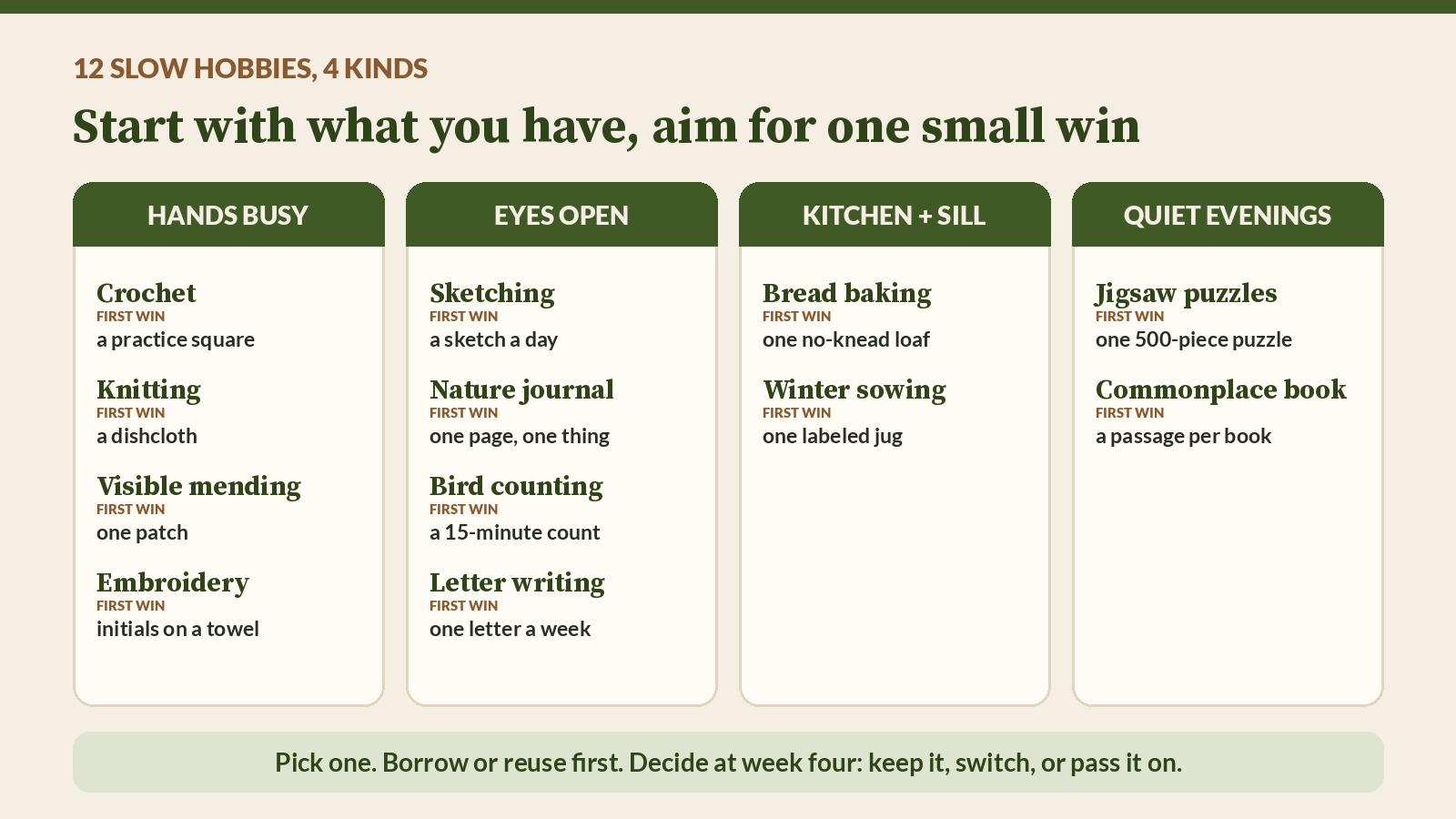
The 12 slow hobbies at a glance
| Hobby | Start with | Borrow or reuse first | First small win |
|---|---|---|---|
| Crochet | Medium weight yarn + one hook | Library book, spare hook | A 7 by 9 inch practice square |
| Knitting | Medium weight yarn + one pair of needles | Thrift store needles | A garter stitch dishcloth |
| Visible mending | Needle, thread, fabric scraps | Clothes that need fixing | One patch or darned sock |
| Embroidery | Hoop, needle, floss | An old tea towel | Initials or a leaf sprig |
| Sketching | Pencil + pocket notebook | Old notebook pages | A sketch a day for a week |
| Nature journaling | Pencil + notebook | A window or a short walk | One page about one thing |
| Bird counting | A window | Library field guide | A 15-minute count |
| Letter writing | Paper, envelopes, stamps | Cards already in a drawer | One letter a week |
| Bread baking | Flour, yeast, salt, water | Your own bowl and baking sheet | One no-knead loaf |
| Winter sowing | Jugs, potting mix, seeds | The recycling bin | One labeled jug |
| Jigsaw puzzles | One puzzle | A puzzle swap | A 300 to 500 piece puzzle |
| Commonplace book | A notebook | Whatever you’re reading | One passage per book |
More on slower evenings and paper habits is in Analog Life, and the low-waste side of things lives in Sustainable Living. If winter also means a home reset, start with the weekly home reset routine.
Sources
- Michaels, Michaels Unveils 2026 Creativity Trend Report (press release, March 10, 2026)
- Mak, H. W., et al., Hobby engagement and mental wellbeing among people aged 65 years and older in 16 countries, Nature Medicine (2023)
- Craft Yarn Council, Standard Yarn Weight System
- Craft Yarn Council, Learn Single Crochet
- John Muir Laws, Three prompts for deeper nature observation
- Cornell Lab of Ornithology and Birds Canada, Project FeederWatch: Project Overview
- National Audubon Society, Join a Christmas Bird Count
- National Audubon Society, Answers to your top questions about the Christmas Bird Count
- King Arthur Baking, The best bread recipes for beginners
- Penn State Extension, Starting Seeds in Winter
- University of Missouri Extension, Winter Sowing Seeds
Save this for later
Pin it to your Sustainable Living board so the swap list is there the next time something runs out.
Printable bundle · $5 launch price
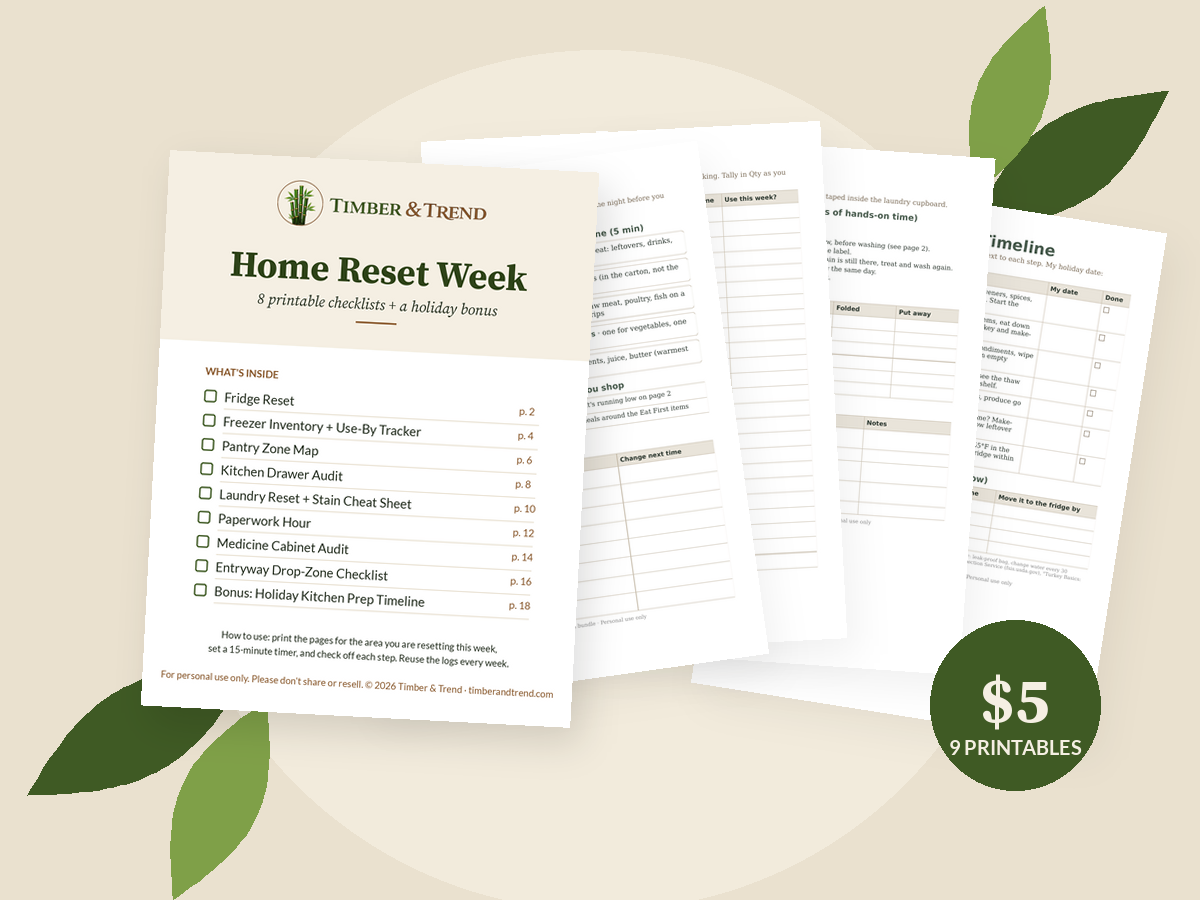
Get every checklist in one place
The Home Reset Week bundle has 8 printable resets (fridge, freezer, pantry, drawers, laundry, paperwork, medicine cabinet, entryway) plus a holiday kitchen prep timeline.